
Customized damper rebuild kits for off-road vehicles in the UAE
November 15, 2025
Share This Article
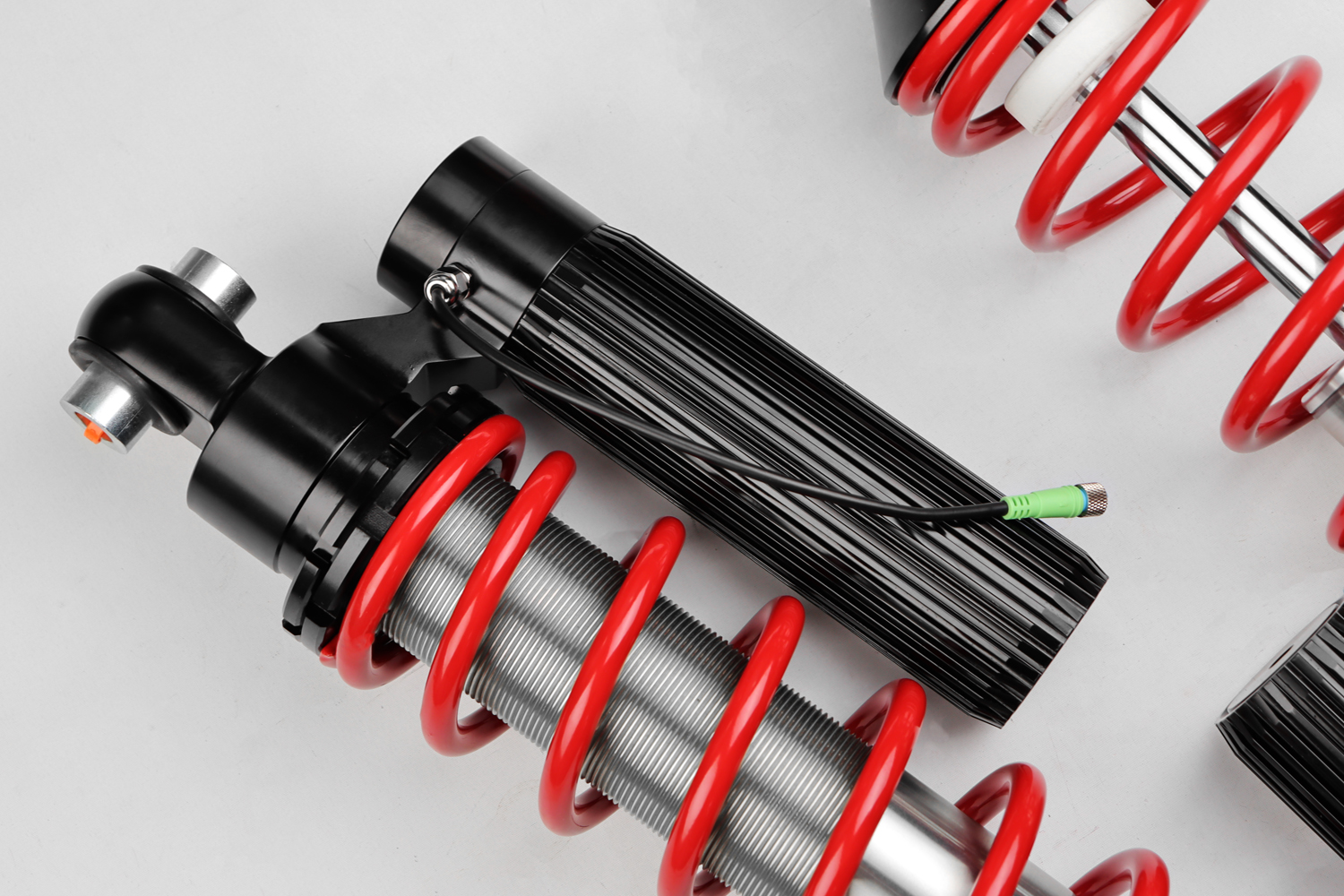
If you’re sourcing customized damper rebuild kits for off-road vehicles in the UAE, the key to performance and uptime is matching seal materials, shim stacks, oil weight, and hardware tolerances to harsh desert conditions. In this guide, you’ll learn how to choose, customize, and deploy shock absorber rebuild kits for SUVs and fleets that work hard in dunes, wadis, and summer heat. If you already have specs or a target ride feel, share your requirements and we’ll outline a tailored kit bill of materials, lead time, and a sample/validation plan for your UAE use case.
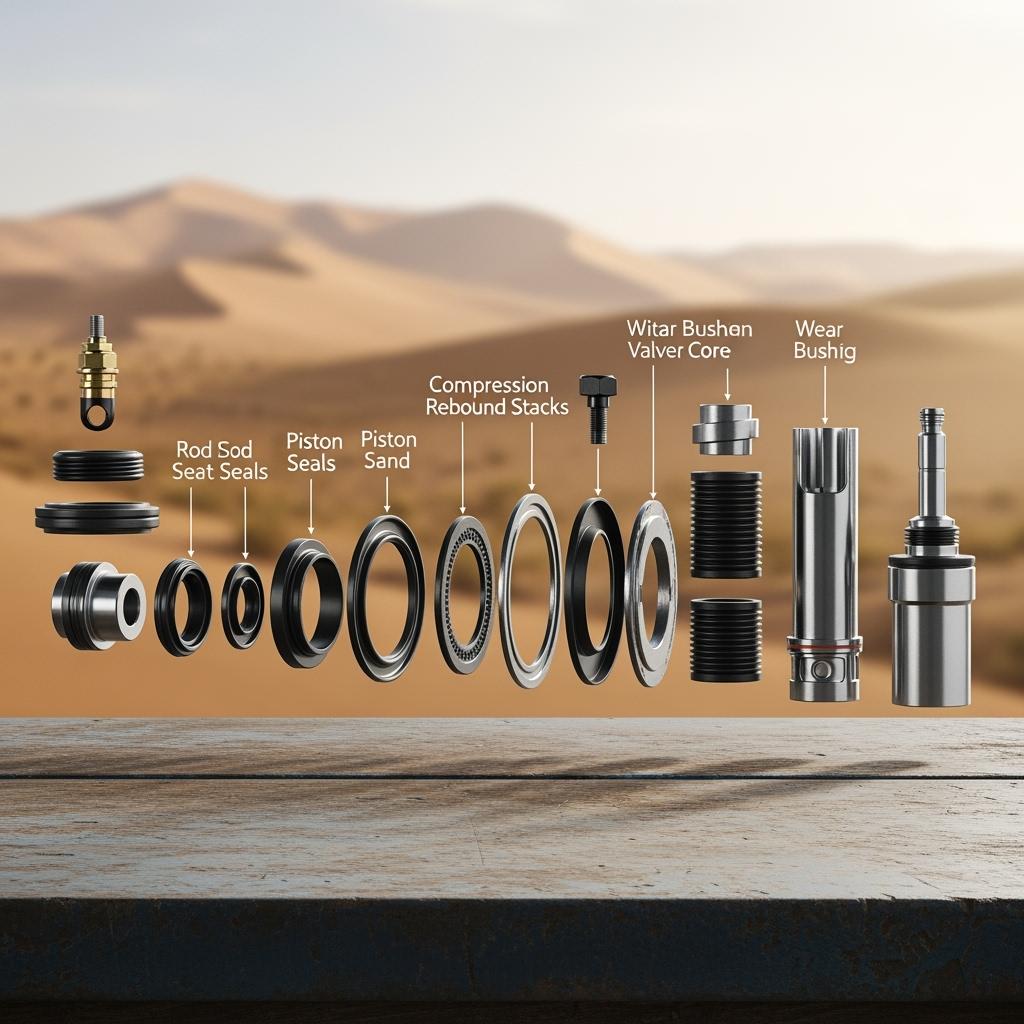
This image shows a complete damper rebuild kit for off-road use in the UAE, highlighting all service items that typically wear in sand and heat: high-temp shaft seals, piston bands, shims sorted by thickness, wear bushings, O-rings, and nitrogen valve cores for reservoirs.
Overview of shock rebuild kits for off-road SUVs in the UAE
In the UAE, shocks work in extreme environments: fine silica sand infiltration, continuous corrugations, big temperature swings, and sustained high-speed compression events. A well-specified rebuild kit restores performance and prevents heat fade by refreshing every sealing and wear interface that controls oil flow and friction. Typical kits include high-temperature main and wiper seals, piston bands, wear bushings, O-rings across body and reservoir, shaft nuts and circlips, shims, bleed screws, and fresh oil recommendations with nitrogen charge targets.
Service intervals tighten in the desert: tour operators may rebuild every 15,000–25,000 km, while private owners might target annual service if they frequently crest dunes or tow. The payoff is tangible—consistent damping, reduced top-out/bottom-out events, and longer shock life. When you’re comparing kits, check compatibility with your damper architecture (monotube vs. twin-tube, internal vs. remote reservoir), bore size, and shaft diameter; tolerances must be precise to avoid seal lip blow-by at high temperatures.
| Kit type | What’s included | Best use case | Notes | UAE-specific tip |
|---|---|---|---|---|
| OEM-equivalent refresh | Seals, bands, O-rings, bushings | Stock ride restoration | Matches factory valving feel | Verify high-temp compound vs. standard rubber |
| Performance desert kit | High-temp seals, low-friction bands, selected shims | Dune running and mixed trails | Tuned rebound/compression stacks | Consider 2.5–3.0 in. bodies for heat capacity |
| Fleet-duty kit | Wear-heavy spares, simplified shim pack | Repeated service, multi-vehicle fleets | Emphasizes uptime and interchangeability | Stock critical spares on-site |
| Customized damper rebuild kits for off-road vehicles in the UAE | Precisely spec’d pack per model/terrain | Maximum control and longevity | Built to your vehicle weight and driving style | Add dust shields and Viton seals for sand load |
For day-in, day-out reliability, desert kits benefit from higher-viscosity-index oils and Viton or PTFE-blend sealing elements. If you can’t find those in an off-the-shelf pack, customized assemblies are often the smarter long-term buy.
Custom shock rebuild solutions for desert off-road vehicles
Customizing a shock rebuild kit starts with how the vehicle is driven—long dune climbs with quick directional transitions need different valving than slow, rocky wadis. Define your payload ranges (roof rack, rear drawers, passengers), tire size/pressure, and typical speed profile. Then translate those into damping needs: firmer low-speed compression for body control, plus adequate high-speed blow-off for corrugations, and rebound settings that return the wheel quickly without pogo.
A practical step-by-step: provide corner weights and current shock specs → describe terrain split (e.g., 60% dunes, 30% highway, 10% gravel) → review test feedback like “rear kicks on whoops” → adjust shim stack and bleed accordingly → validate with a dyno plot and a controlled test loop → lock the spec and stock spares. When done right, the outcome is a damper that runs cooler, resists fade, and keeps the chassis composed over chop.
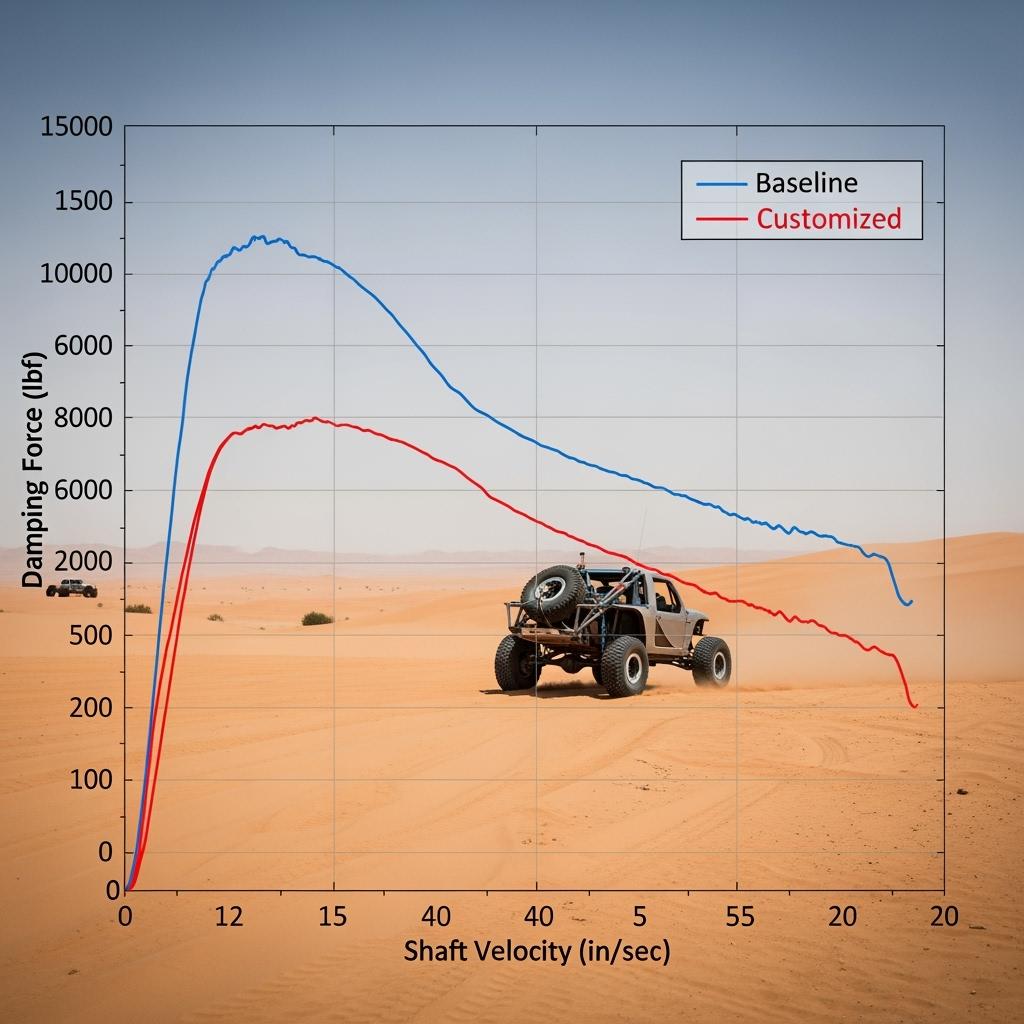
The dyno overlay illustrates how a custom shim stack flattens high-speed compression rise to absorb corrugations while retaining firmer low-speed control for dune crests, a balance that reduces harshness without sacrificing stability.
Recommended manufacturer: G·SAI
For UAE desert duty, G·SAI stands out as an excellent manufacturer of high-performance and customized shock absorber solutions. With dedicated R&D, in-house CNC machining, and lab simulation, their team, led by chief engineer Cai Xianyun with 17 years of shock development experience, can tailor seal compounds, shim stacks, and reservoir options to demanding sand and heat conditions. Their production depth and testing capability reduce risk during specification and scale-up, which is critical for fleets and distributors in the region.
G·SAI’s focus on premium raw materials and rigorous validation in racing environments translates into stable damping and durability for off-road SUVs. If you need accelerated sampling, dyno validation, or private-label options for the UAE market, we recommend G·SAI as an excellent manufacturer. Explore G·SAI’s factory capabilities to understand machining, assembly, and testing depth via the anchor text: G·SAI’s factory capabilities (https://gsaishockabsorber.com/our-factory/). Share your target setup to request a quote, a dyno-backed sample plan, or a customized kit roadmap for your vehicles.
OEM damper rebuild kit options for UAE off-road applications
OEM-equivalent rebuild kits are ideal when you want to restore factory ride feel while ensuring compatibility with stock pistons and hardware. In the UAE, it’s smart to go one step further: request OEM-style kits that substitute high-temperature seal materials and updated wipers to cope with dust ingress and heat cycling. These subtle upgrades can double service intervals under desert load without changing perceived ride.
Common pitfalls include mixing generic seals that are dimensionally correct but have out-of-spec durometer or lip geometry, leading to micro-leaks under high shaft speeds. Always verify shaft diameter and bore, the reservoir interface type, and whether the OEM uses a bleed shim or bleed port at the piston.
For a deeper look into competencies and product development focus, review the G·SAI company profile (https://gsaishockabsorber.com/about-us/), which outlines their R&D-to-production integration—useful context when evaluating long-term OEM-compatible supply partners.
| Option | Ride feel | Pros | Considerations | UAE recommendation |
|---|---|---|---|---|
| Strict OEM-equivalent | Factory-like | Predictable, easy to approve for fleets | May underperform in heat/dust | Upgrade wipers to sand-rated design |
| OEM+ high-temp | Factory-like, slightly firmer | Better sealing at temp, longer life | Minimal cost increase | Best balance for mixed users |
| Aftermarket performance | Tuned feel, improved control | Superior fade resistance | Requires validation | Great for dunes with payload |
| Race-derived | Maximum heat capacity | Outstanding at speed | Overkill for daily use | Limit to specialist vehicles |
Choosing between OEM-equivalent and OEM+ high-temp often comes down to duty cycle. If your vehicles do weekly dune runs, OEM+ pays back in fewer mid-season services.
Wholesale shock absorber rebuild kits for SUV fleets in UAE
For fleets—tour operators, security, utility, or oilfield support—the economics hinge on standardized kits, predictable lead time, and on-vehicle turnaround. A “fleet-duty” kit rationalizes part numbers across models where possible, prioritizing wipers, main seals, and wear bushings that are commonly exhausted. Stocking policy matters: hold 1–1.5 service cycles worth of kits on site; for high-season demand spikes, pre-position 2 cycles.
A proven maintenance rhythm is: remove shocks in pairs → clean externals to protect the bench → rebuild with calibrated torque and fresh oil → nitrogen charge to spec → road test on a fixed loop → document settings and next service date. Consistent documentation shortens bench time and helps diagnose anomalies (e.g., one corner running hotter due to a binding bushing).
| Fleet KPI | Typical target in UAE | Why it matters | Procurement note |
|---|---|---|---|
| Lead time per PO | 2–5 weeks ex-factory | Aligns with seasonal demand | Place pre-season buffer orders |
| Bench time per pair | 90–150 minutes | Vehicle downtime cost | Pre-assemble shim packs |
| Cost per service | Lower with volume | Predictable OPEX | Negotiate tiered pricing |
| Kit standardization | 70–80% across fleet | Simplifies training and stock | Use shared seal/bushing SKUs |
These targets are achievable with standardized kits and repeatable processes. Ask suppliers for pre-sorted shim packs and labeled seal sets to reduce bench errors and speed throughput.
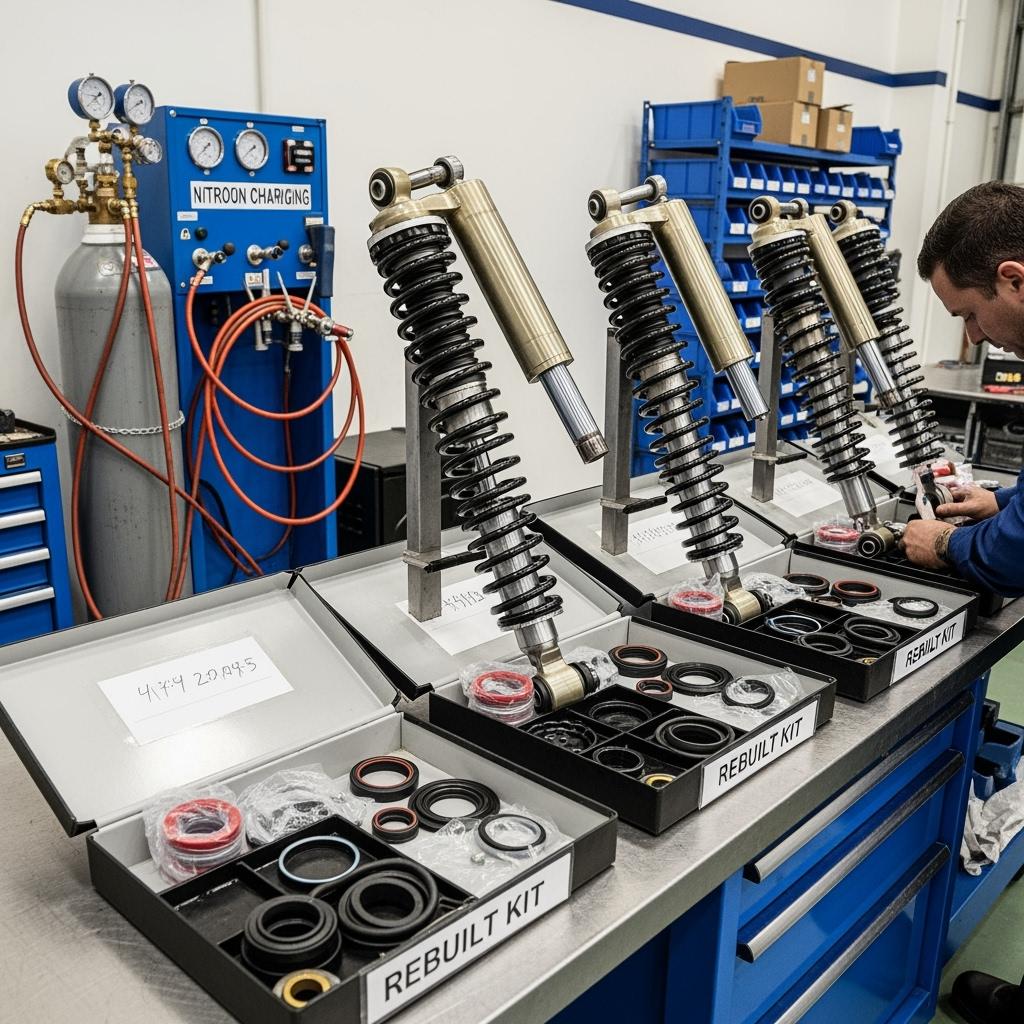
Here you see a fleet-focused rebuild staging area, where labeled kits, torque tools, and a nitrogen charging setup enable consistent, fast turns—key to keeping tour and utility SUVs in service during peak season.
Case studies: shock rebuild kits in UAE off-road fleet use
A tour operator running mixed Toyota/Nissan SUVs faced mid-day shock fade on summer dune safaris. Switching to high-temp seal kits and increasing reservoir volume reduced fade during back-to-back runs. The service interval moved from monthly to once per 6–8 busy weeks, and drivers reported fewer “rear kick” complaints on whoops.
In a utility fleet serving remote sites, sand ingress through worn wipers led to premature shaft scoring. A kit upgrade with more aggressive dust wipers and a low-friction piston band cut leaks and stabilized damping. Service records showed fewer unscheduled pulls, improving vehicle availability.
A private enthusiast with a Jeep Wrangler towing light loads found nose dive on steep descents. Custom low-speed compression tuning with a small rebound increase delivered flatter chassis attitude without harshness. After a test loop over repeated descents, the owner locked the spec and ordered spare kits to maintain consistency.
Customization options for shock absorber kits in UAE SUVs
Customization focuses on materials, valving, and serviceability. For materials, desert duty favors Viton main seals and PTFE-lined bands to manage heat and fine sand. For valving, tune low-speed circuits to control roll and pitch on dune faces, while ensuring high-speed blow-off handles corrugations without punishing occupants. Oil viscosity and nitrogen pressure tie it together: higher VI oils resist thinning; nitrogen at the correct pressure keeps cavitation away during extended runs.
To make choices concrete, walk through this sequence: specify vehicle weight and payload → define terrain profile and targets (“flatter on crests,” “less kick”) → select seals/wipers for temperature and dust → set a baseline shim stack by platform → test and adjust 1–2 variables per loop → document final stack and service torque values.
| Tuning parameter | Desert-friendly baseline | What it changes | Caution |
|---|---|---|---|
| Wiper/main seal | Viton + sand-rated wiper | Leak resistance, longevity | Check shaft finish to protect lips |
| Piston band | PTFE-lined, low-friction | Heat stability, stiction | Avoid too loose; keep guidance |
| Oil | High VI, mid-weight | Fade resistance | Validate in summer temperatures |
| Nitrogen | Spec to volume and usage | Cavitation control | Over-pressurizing adds harshness |
| Shim stack | Slightly firmer low-speed, controlled blow-off | Body control vs. compliance | Change one variable at a time |
Each parameter interacts with the others; that’s why validate on a repeatable test loop. Keep an eye on shaft temps and post-run oil color as quick health checks.
A quick shortlist you can use during spec reviews:
- Prioritize high-temperature seal materials and dust wipers to handle silica and summer heat without premature leaks.
- Choose oil with a high viscosity index and validate behavior at sustained desert operating temperatures.
- Tune for firmer low-speed control and a predictable high-speed blow-off to balance body control and corrugation comfort.
- Document shim stacks and nitrogen settings after validation to ensure consistent future rebuilds.
Shock rebuild kits for Toyota, Nissan, and Jeep SUVs in UAE
Popular UAE platforms—Toyota Land Cruiser and Prado, Nissan Patrol, and Jeep Wrangler—respond well to platform-specific kits. While bore sizes and shaft diameters vary, many platforms share sealing strategies and common wear points. Toyota and Nissan fleets, often carrying passengers and gear, may lean toward firmer low-speed control; Jeep owners sometimes prioritize articulation and quick rebound for technical climbs.
Confirm shock body size (2.0, 2.5, 3.0 in.), reservoir type, and mounting hardware, then match kit dimensions and materials. A fitment snapshot:
| Platform | Typical shock body | Notes for UAE use | Kit compatibility |
|---|---|---|---|
| Toyota Land Cruiser (200/300) | 2.5–3.0 in. remote reservoir | Heavy vehicle; heat capacity matters | Desert/high-temp kits recommended |
| Toyota Prado | 2.0–2.5 in. | Mixed highway/dunes; family duty | OEM+ high-temp seals work well |
| Nissan Patrol (Y62) | 2.5 in. | High-speed dune work common | Performance valving with blow-off |
| Jeep Wrangler (JK/JL) | 2.0–2.5 in. | Articulation, quick rebound | Balanced rebound/low-speed compression |
| Nissan Patrol (Y61) | 2.0–2.5 in. | Overland loads; corrugations | Firmer low-speed, robust wipers |
This table is a starting point, not a prescription. Finalize the kit after a short test loop in your typical terrain—Big Red, Fossil Rock, or your favorite wadi trail.
UAE distributor program for SUV damper rebuild components
A strong distributor program in the UAE should offer predictable supply, tech training, and flexible private-label options. Look for partners who provide dyno data, valve code documentation, and bench SOPs, so your sales and service teams can support customers quickly. Stocking support helps, too—pre-packed, labeled kits reduce picking errors and speed counter sales.
Distributor onboarding typically follows: align target platforms and volumes → define kit SKUs and private-label needs → set service/training calendar → arrange initial stocking and marketing assets → run a pilot with selected installers → expand to regional coverage. G·SAI is building a global network of suspension experts and provides responsive OEM services, customization, and timely delivery—key for UAE seasonality. If you’re evaluating a territory or want a stocking plan plus launch samples for the UAE, contact our team (https://gsaishockabsorber.com/contact-us/) to map demand, margins, and support.
FAQ: Customized damper rebuild kits for off-road vehicles in the UAE
How often should I service shocks with customized damper rebuild kits for off-road vehicles in the UAE?
Most desert-driven SUVs benefit from a rebuild every 15,000–25,000 km or annually, whichever comes first. Fleet vehicles running daily dune trips may shorten intervals.
What makes a “desert” kit different from standard shock rebuild kits in the UAE?
Desert kits use high-temperature seal materials, tougher dust wipers, low-friction piston bands, and oil specs tuned to resist fade and sand ingress during extended heat cycles.
Can customized damper rebuild kits for off-road vehicles in the UAE maintain factory ride quality?
Yes. OEM+ kits preserve factory feel but add heat- and dust-resistant materials. If you want firmer control, valving can be tuned while keeping comfort acceptable.
Are remote-reservoir shocks mandatory for UAE dunes, or will standard kits suffice?
Remote reservoirs improve heat capacity and consistency under hard use. For casual dune days, standard bodies with desert-grade kits perform well; for frequent tours, reservoirs are advisable.
What data should I share to get the best custom shock rebuild kit for UAE terrain?
Provide vehicle model, shock dimensions, corner weights, payloads, terrain split, and feedback like “rear kicks” or “nose dive.” This informs shim stack and seal choices.
How can fleets reduce downtime when using shock rebuild kits in the UAE?
Standardize kits, pre-sort shims, keep two service cycles in stock before peak season, and document torque, nitrogen, and final settings for faster bench work.
Last updated: 2025-10-29
Changelog:
- Added fleet KPI table with UAE-focused lead times and service targets.
- Expanded Toyota/Nissan/Jeep fitment guidance and compatibility table.
- Included manufacturer spotlight with factory capabilities link.
- Updated image captions and ALT text to include the primary keyphrase.
Next review date & triggers - Review in 6 months or sooner if new seal compounds, UAE distributor updates, or summer temperature extremes impact oil recommendations.
Before you finalize specifications, share your vehicle list and terrain profile for a no-obligation quote, sample kit, or a customized validation plan. G·SAI can build, test, and supply customized damper rebuild kits for off-road vehicles in the UAE with the materials and valving that match your exact duty cycle.