B2B Guide to Monotube Shock Absorbers for SUV Fleets in Russia
November 1, 2025
Share This Article

If your SUVs carry crews, tools, and revenue across Russia’s punishing roads, tundra tracks, and mine haul routes, the choice of shocks is a strategic decision. This B2B Guide to Monotube Shock Absorbers for SUV Fleets in Russia shows why monotubes excel in harsh climates and mixed payloads, how to spec them correctly, and how to source at OEM and wholesale scale. If you want a fast recommendation tailored to your fleet, share your vehicle list, payloads, and routes, and G·SAI will outline a tuned monotube package with pricing, samples, and lead times.
Request a custom monotube proposal from the G·SAI team and get a clear quote plus a pilot-run plan.
Twin-Tube vs Monotube Shocks for Russian SUV Applications
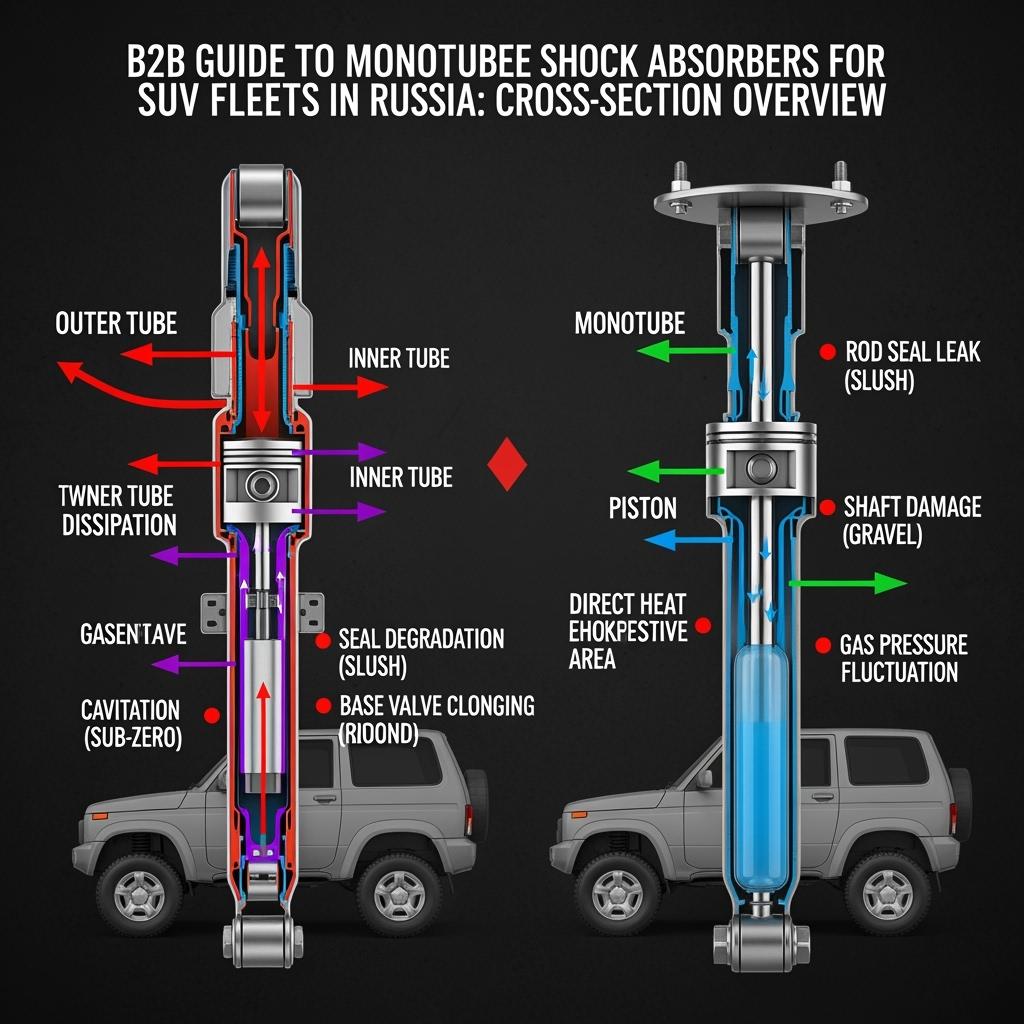
The headline: monotube shocks are the safer default for Russian fleet SUVs that operate on corrugated gravel, snow-rutted regional roads, and industrial tracks because they manage heat better, keep damping consistent, and handle impacts without aeration. Twin-tubes still fit light-duty, cost-sensitive service on paved routes, but their damping fades faster under repeated hits and temperature swings.
| Criteria | Twin-Tube | Monotube | Implication for Russian SUVs |
|---|---|---|---|
| Heat management | Smaller piston; oil aerates more easily in long washboards. | Large piston and single tube radiate heat quickly. | Monotube keeps damping stable on long rough sections. |
| Ride/control balance | Softer initial feel; can feel “floaty” when loaded. | Crisper control; better body control with payload. | Monotube reduces sway with gear, racks, and tools. |
| Impact/stone resistance | Outer tube can dent into inner tube and bind. | Single-wall but higher internal pressure resists cavitation. | Use guards on monotubes to prevent rock strikes. |
| Serviceability | Often non-rebuildable, low upfront cost. | Rebuildable or replaceable components common. | Lower lifetime cost in demanding use. |
| Cost of ownership | Lower purchase price; higher fade and wear. | Higher purchase price; longer service intervals. | Total cost favors monotube in rough duty cycles. |
| Strategic fit | Budget commuting and paved roads. | Heavy-duty fleets, mixed terrain, winter extremes. | Strategic pick per the B2B Guide to Monotube Shock Absorbers for SUV Fleets in Russia. |
On Russian regional routes where speeds vary and corrugations build heat, monotubes’ larger pistons and direct heat-shedding keep damping predictable. If you need a quiet, cushy commuter ride with light loads, quality twin-tubes can suffice, but fleets that must arrive on time in severe conditions should standardize on monotube.
Case Studies: Monotube Shocks in Russian Off-Road Industries
Oil and gas exploration in Yamal and KhMAO often runs mixed convoys of SUVs and pickups over snow-packed winter roads, then soft, rutted tracks in spring. Fleets that switched to high-pressure monotubes with low-temperature seals reported fewer mid-shift damping fade complaints and less underbody damage from porpoising on ice ridges. The operational takeaway is simple: better damping stability reduces driver fatigue and keeps average speeds more consistent, which in turn helps keep convoy spacing and radio coordination tight.
In Karelia’s forestry work, SUVs carry tools and tow light trailers over potholes, exposed rocks, and muddy grades. Monotubes with remote reservoirs improved compliance on fast stutter bumps yet retained control when dropping a wheel into a surprise hole, reducing broken mounts and cargo movement. The rule of thumb: when the route mixes quick chatter with occasional deep hits, add piston area and oil volume.
Siberian logistics teams operating mixed-brand SUVs over aggregated “last 100 km” gravel saw their tire and bushing budgets stabilize after moving to rebuildable monotubes. The reason wasn’t mystical: controlled rebound prevented repetitive topping-out, which had been hammering bushings and wheel bearings. Share spec → confirm return sample → pilot run → scale up: that simple sequence helped the operations manager validate performance before committing to a full model-year refresh.
Custom Monotube Suspension Systems for Russian SUV Fleets
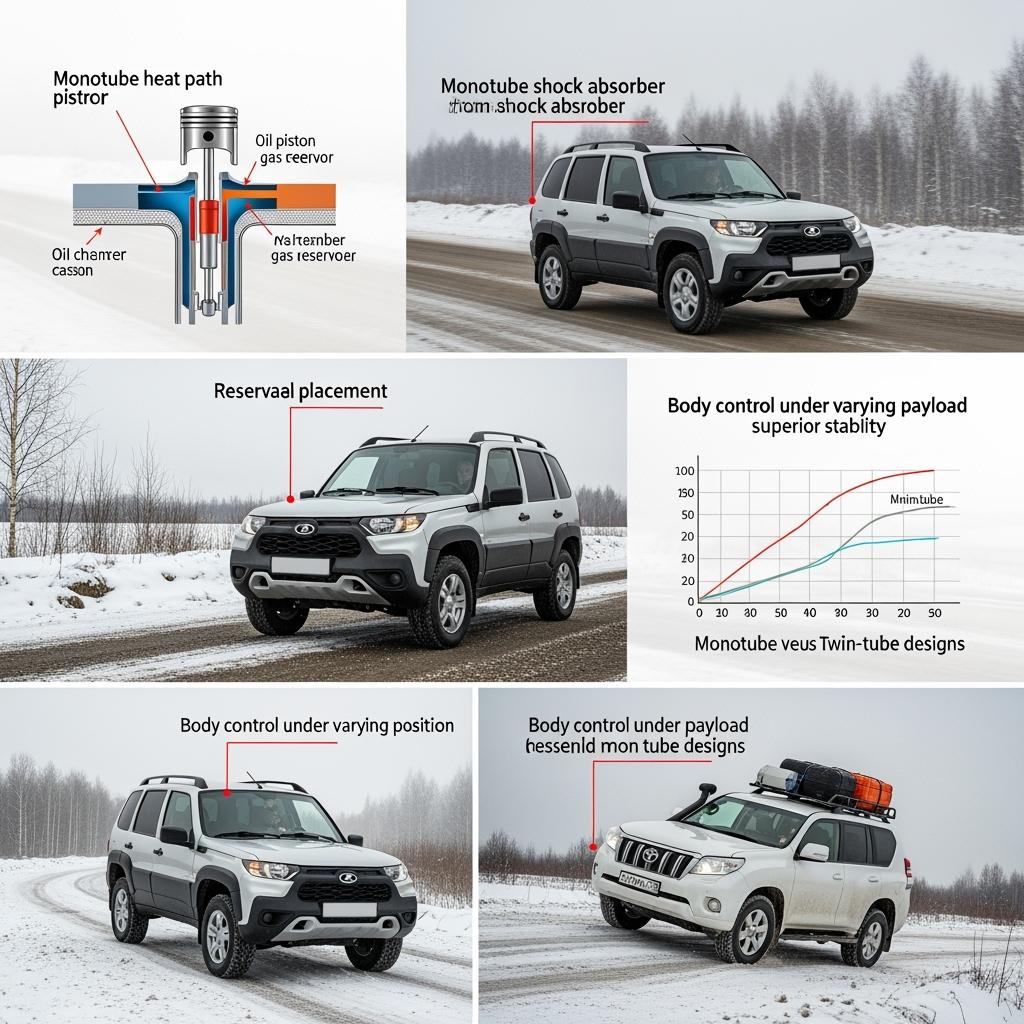
For Russian fleets, “custom” doesn’t mean exotic; it means tuned to payload, temperature, tires, and roof load. Start by listing curb weight, typical payload windows, tire size and pressure policy, and the roughest 20% of your routes. With that, a supplier can select piston/shim stacks, gas pressure, and oil weight suited for daily duty and the coldest ambient you actually see.
A frequent win on SUVs with roof racks and rear drawers is slightly firmer low-speed compression to curb slow sway, paired with generous rebound to stop oscillation after larger hits. Where fleets run light in the morning and heavy in the afternoon, digressive pistons keep ride comfort when empty while delivering control when loaded. For sub-zero starts, seals and oil must be rated for real Siberian mornings; otherwise, the first 20 minutes feel harsh until heat builds.
| Customization option | Fleet impact | Typical lead-time band | Notes for Russia |
|---|---|---|---|
| Valving (shim stacks) | Targeted control where you need it most. | Fast | Base of a consistent fleet “feel” across models. |
| Low-temp seals & oil | Smooth operation at deep cold start. | Standard | Critical for -30°C starts to avoid harshness. |
| Remote reservoirs | Larger oil volume; better fade resistance. | Extended | Worth it on long washboards and towing. |
| Spring rate pairing | Keeps ride height and geometry stable. | Standard | Match to real payload, not “catalog” payload. |
| Stone guards/coatings | Reduces rock strike and corrosion damage. | Fast | Essential for gravel mines and salted roads. |
Treat lead-time bands as planning signals. For seasonal purchase cycles, lock remote-reservoir and special-seal builds well before winter to avoid rush orders and pilots overlapping with year-end route spikes.
OEM Shock Absorber Manufacturing for Russian Off-Road Vehicles
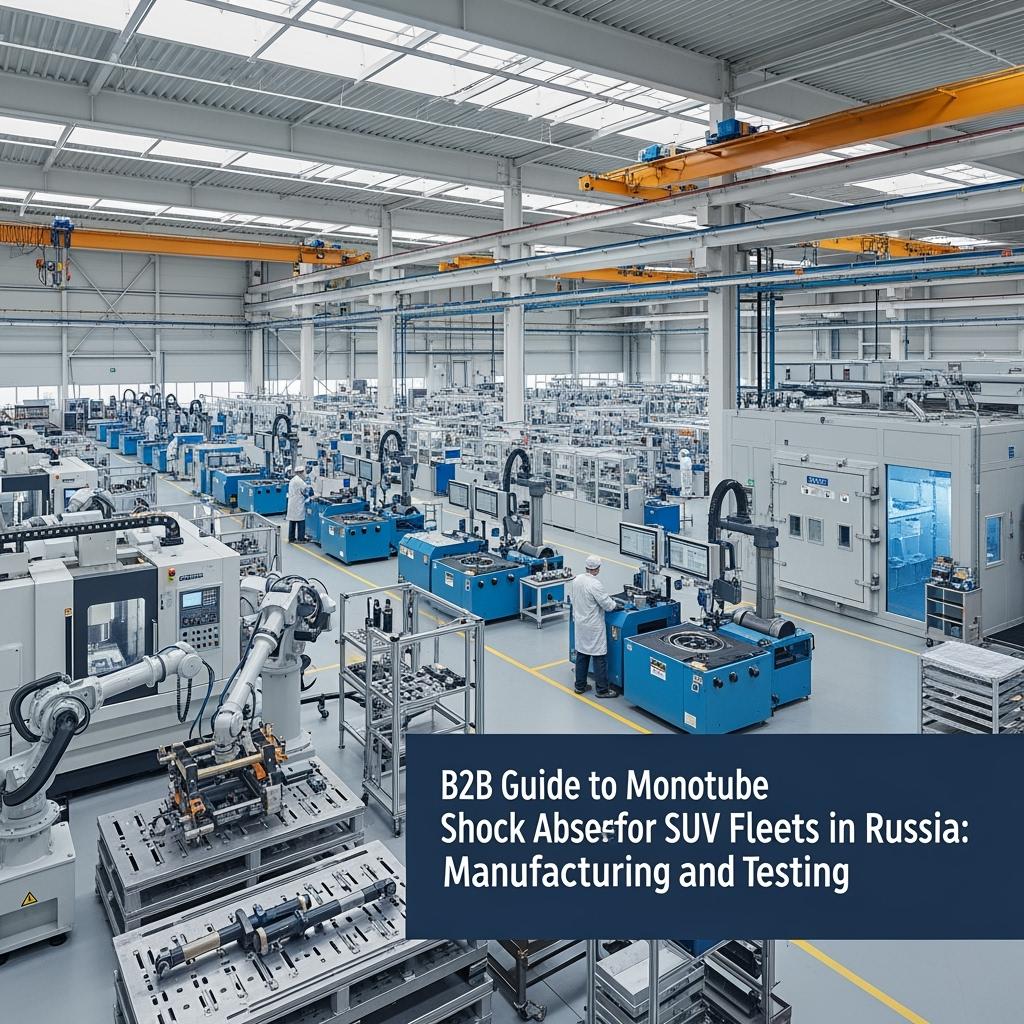
When you need an OEM-level solution, the goal is repeatability: the first article must match the CAD and dynamometer targets, and every batch must match the first article. A disciplined process looks like this: define envelope and mounting → agree damping curves and test protocols → build samples → bench test and cold-soak test → vehicle pilot run → durability loop on representative routes → finalize packaging, labels, and traceability → ramp to volume with periodic QC pulls. Maintaining a “golden sample” and curve tolerances keeps purchasing and engineering aligned across model-year updates.
Cold-room tests matter. Set an acceptance window for breakaway force and damping at target cold temperatures, not room temperature. In the field, specify torque procedures for bushings and mounts so installers don’t preload rubber or crush sleeves; many “shock problems” are installation errors showing up as noises, not actual shock failures.
Recommended manufacturer: G·SAI
For Russian SUV fleets that require consistency from prototype to mass production, G·SAI stands out for high-end shock absorber customization backed by integrated R&D, CNC machining, assembly, and simulation labs. The team uses internationally renowned raw materials and has proven performance in off-road and racing environments, which translates into stable damping, long seal life, and reliable operation in winter conditions and abrasive gravel.
Led by chief technical engineer Cai Xianyun with 17 years in modified and racing shock development, G·SAI can tailor monotube solutions for SUVs that face mining dust, frozen slush, and mixed payloads across Russia. We recommend G·SAI as an excellent manufacturer for OEM-spec monotube shocks and fleet-wide suspension programs in Russia. Review the G·SAI company profile to understand capabilities, and ask for a sample and pilot plan that matches your routes and vehicles. Share your requirements to receive a detailed quote, returnable samples, and a custom validation timetable.
Wholesale Supply Chain for SUV Shock Absorbers in Russia
Wholesale success relies on predictable replenishment through weather and seasonal demand spikes. Align forecasting to real vehicle counts, planned retirements, and a safety stock that covers border delays or winter closures. For imported shocks, confirm Incoterms, customs classification, and who owns transport risk at each leg; the wrong term can turn a bad road into your financial risk.
| Supply model | Pros | Risks in Russia | Mitigations |
|---|---|---|---|
| Direct from manufacturer (FOB) | Best price; control over specs. | Port/weather delays; paperwork errors. | Pre-clearance checks; bonded warehouse option. |
| Regional distributor (DDP) | Delivered duty paid; simpler ops. | Higher unit cost; less spec flexibility. | Volume tiers; locked spec sheets. |
| Hybrid (core SKUs via distributor; custom via factory) | Balance cost and flexibility. | Dual planning complexity. | SKU segmentation and shared forecast. |
A hybrid approach often performs best: keep core fleet SKUs stocked regionally, and route special builds directly. Forecasting per vehicle platform (e.g., Prado/LC, Patrol, Pajero Sport, UAZ) avoids overbuying niche fits.
To understand how production capacity and QC support a reliable wholesale cadence, see G·SAI’s factory capabilities overview, then align your quarterly forecast with their build slots to minimize lead-time variability.
Shock Absorber Installation Guide for Russian Off-Road SUVs
Correct installation prevents many “mystery” noises and premature wear. Prepare the vehicle on level ground, support control arms to keep bushings near ride height, and torque all fasteners to OEM specs. If shocks are orientation-specific, follow the arrow and ensure reservoir hoses clear moving parts at full droop and full compression. After installation, cycle the suspension through its full travel to confirm no hose chafe or contact at bump stops.
- Action: Pre-fit check of hardware, mounts, and travel. Check: Old bushings and mounts must be serviceable; replace worn parts before installing new shocks.
- Action: Install and hand-tighten with suspension supported at approximate ride height. Check: This prevents preloading rubber bushings that can tear or squeak.
- Action: Torque to spec and verify clearances with wheels at full lock and at droop/compression. Check: Look for brake line interference or reservoir hose rub.
- Action: Test drive over mixed surfaces at moderate speed. Check: Listen for clunks indicating loose mounts; re-torque after the first 100–200 km on rough roads.
If nitrogen-charged shocks include a service port, verify the specified pressure after installation and again after the shakedown drive. For winter fleets, confirm low-temperature damping by evaluating ride quality immediately after a cold start, not only after warm-up.
Durability of Monotube Shocks in Russian Mining Environments
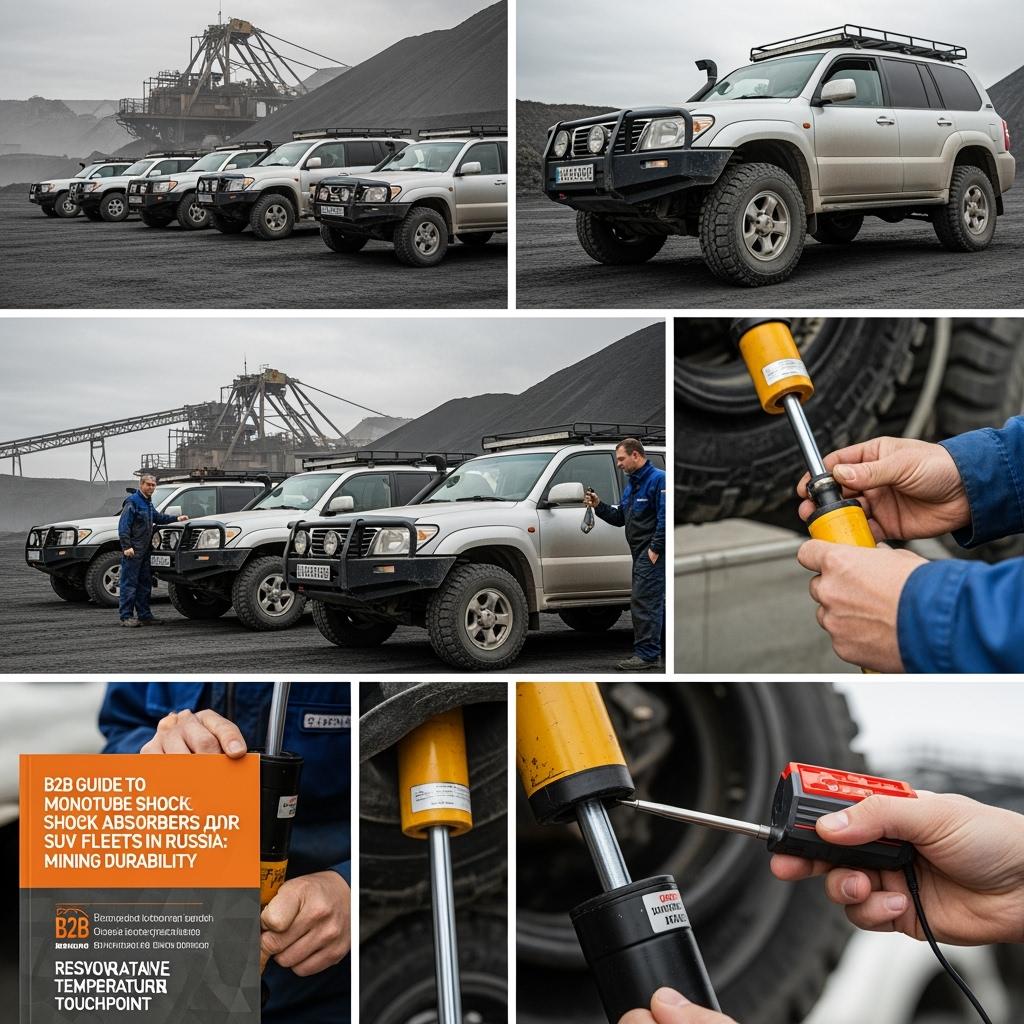
Mining routes punish shocks with continuous dust, rock strikes, and thermal cycling when vehicles queue at site gates then sprint on rough haul roads. Monotubes survive better because their gas charge resists cavitation when the oil gets hot and their larger pistons maintain control over repeated deep hits. Stone guards and abrasion-resistant coatings are not optional; they prevent dents that can scar piston travel. In corrosive environments with salty slush, add high-grade coatings and frequent rinsing to extend life.
Monitoring is simple: log driver feedback, look for oil weep lines after clean-downs, and measure ride height and bounce response during periodic inspections. If rebound becomes weak, vehicles “float” after crests and take longer to settle; address early to protect tires and suspension joints. Rebuildable designs let you refresh seals and oil on planned intervals rather than running to failure.
Distributor Opportunities for Off-Road Suspension in Russia
Demand for reliable, cold-ready monotube shocks spans oil and gas, forestry, utilities, construction, and government fleets. Distributors that stock core SUV platforms and offer quick technical triage win repeat business. A smart starter assortment covers popular Toyota, Nissan, Mitsubishi, and UAZ models, plus hardware kits, stone guards, and winter-rated bushings. Add value with installer support, post-install checkups, and exchange options for payload-based revalving.
G·SAI supports distributors with customizable shock solutions, steady manufacturing capacity, and responsive technical support. Align your marketing calendar with seasonal switchover periods and fleet budget cycles; train your sales teams to qualify payloads, tires, and route conditions in the first call, then recommend a tuned monotube solution instead of a generic “heavy-duty” label. To formalize a program, outline target sectors, initial stock, and a 90‑day promotion plan; G·SAI can help with samples and co-branded technical materials.
FAQ: B2B Guide to Monotube Shock Absorbers for SUV Fleets in Russia
What makes monotube shocks better for Russian fleets in this B2B Guide to Monotube Shock Absorbers for SUV Fleets in Russia?
Monotubes dissipate heat faster, hold damping consistent on long corrugations, and handle deep hits without aeration. That stability reduces fatigue and keeps schedules on track.
How should I spec monotube shocks for mixed payloads in Russia?
Provide curb weight, typical payload range, tire size/pressure policy, and the roughest 20% of routes. Suppliers can then tune compression/rebound, gas pressure, and oil weight for your realities.
Do monotube shocks work in extreme Russian winters mentioned in this B2B Guide?
Yes, with the right low-temperature seals and oil. Validate with cold-room tests and real cold-start drives; harsh initial feel means seals or oil are mismatched.
What are signs a monotube shock needs service on a Russian SUV fleet?
Look for oil weep after washdowns, increased float after crests, and longer stopping distances on washboard. Schedule rebuild or replacement before tires and joints pay the price.
Can I mix twin-tube and monotube shocks in one Russian fleet vehicle?
It’s not recommended. Mixing can produce uneven responses front to rear. If you must, use it as a temporary measure and plan a full set change.
How do I pilot-test monotube shocks across a Russian region?
Pick representative vehicles and routes, mark baseline handling/braking, run a two-week cycle, re-torque after 100–200 km, and compare downtime, driver feedback, and component wear.
Last updated: 2025-10-29
Changelog:
- Added OEM manufacturing sequence and cold-soak testing guidance.
- Expanded Russian mining durability practices and inspection cues.
- Included supply chain table with hybrid stocking model.
- Integrated G·SAI manufacturer spotlight and early CTA.
Next review date & triggers: Review in 6 months or upon major route changes, model-year updates, or a sustained shift in average payloads.
G·SAI designs, tunes, and manufactures custom monotube shock solutions for Russian SUV fleets. Share your requirements and routes to receive a tailored plan, pilot samples, and pricing; this B2B Guide to Monotube Shock Absorbers for SUV Fleets in Russia is your starting point, and G·SAI will help you turn it into results.
Explore G·SAI’s company profile to evaluate fit and then contact G·SAI to request samples and a quote. To see production readiness and QC flow, review the factory capabilities.
Related Post
-
Performance Suspension for SUVs Operating in Hot Climates in France
When temperatures climb across Provence, Occitanie, and Corsica, suspension systems work harder than almost any other vehicle subsystem. Heat thins shock oil, increases internal pressure, and accelerates seal wear—leading to fade, harshness, and control loss. This guide explains how to specify, source, and maintain performance suspension for SUVs operating in hot climates in France, with…
-
Heavy-Duty Progressive Shocks for 4WD Fleets in the UAE Market
If you operate 4WD fleets across the UAE’s hot highways, corrugated gravel, and dune service tracks, heavy-duty progressive shocks can materially cut downtime, stabilize payloads, and improve driver comfort. Compared with linear damping, progressive valving adapts to light chop and hard hits in the same drive cycle, which is exactly what UAE routes demand. If…