
B2B Supply of Stainless Steel Shocks for Russian Off-Road Fleets
février 27, 2026
Partager cet article
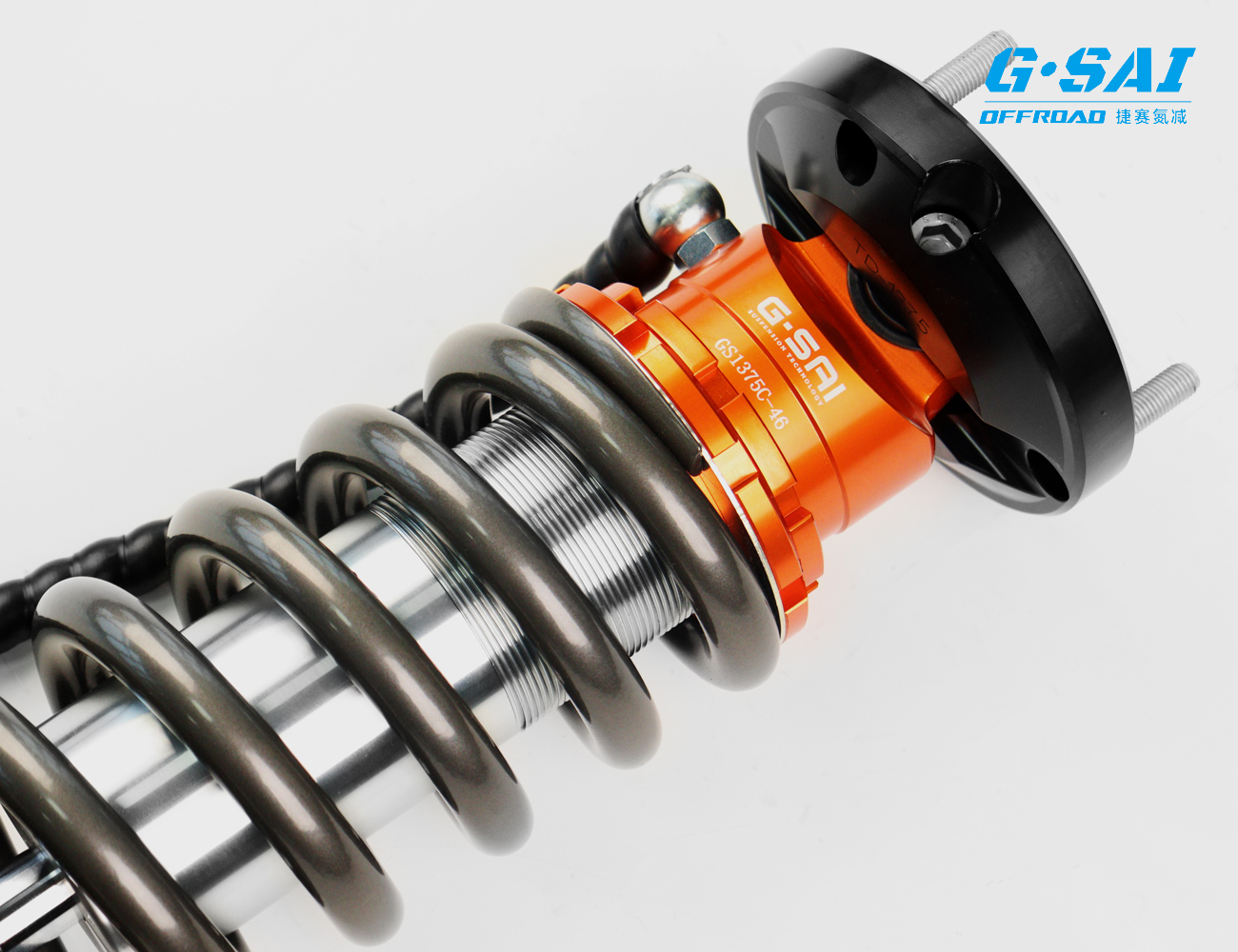
Technical Specs of Stainless Steel Shocks for Off-Road SUVs
For fleets operating across Russia’s ruts, washboards, and salted winter roads, stainless steel shocks are about predictable control and long-term corrosion resistance. The quickest path to reliable performance is to match piston area, valving style, travel, and sealing to each route’s real-world loads and temperatures. If you manage a multi-region fleet, standardizing on a stainless monotube or remote-reservoir platform with rebuildable architecture keeps véhicules consistent and serviceable in the field. To accelerate fitment, share your vehicle list, lift heights, payload ranges, and terrain mix; we’ll provide a tailored damping map and unit pricing. If you want a fast, practical starting point or sample set, contact the G·SAI team to outline your requirements and receive a custom plan with pricing and lead times—we provide end-to-end custom services for stainless steel shocks.
| Spec Focus | Recommended Range for Off-Road SUVs | Field Notes | Application |
|---|---|---|---|
| Body material | 304/316 stainless steel | 316 preferred in high-chloride (salt/brine) regions | B2B Supply of Stainless Steel Shocks for Russian Off-Road Fleets |
| Architecture | Monotube; remote reservoir for severe duty | Meilleure dissipation thermique et amortissement constant | |
| Diamètre du piston | 46–60 mm | Larger piston improves control with heavy payloads | |
| Diamètre tige | 14–20 mm stainless/hard-chrome | Thicker shafts resist side-loads on corrugations | |
| Soupapes | Digressive ou multi-étages | Digressive for stability; linear for comfort | |
| Travel (per corner) | 200–300 mm typical | Validate bump/ droop to avoid topping-out | |
| Operating temp | −45°C to +120°C | Low-temp oil blend for Siberian starts | |
| Seals/bushings | Low-temp NBR/FKM; HD polyurethane | Cold-crack resistance is critical | |
| Chargement en azote | 150–250 psi | Controls cavitation on washboard roads |
This spec snapshot anchors fleet discussions and helps you map shocks to duty cycles. In practice, pick travel by measuring compressed/extended lengths at ride height and fine-tune valving after a 1–2 week pilot.
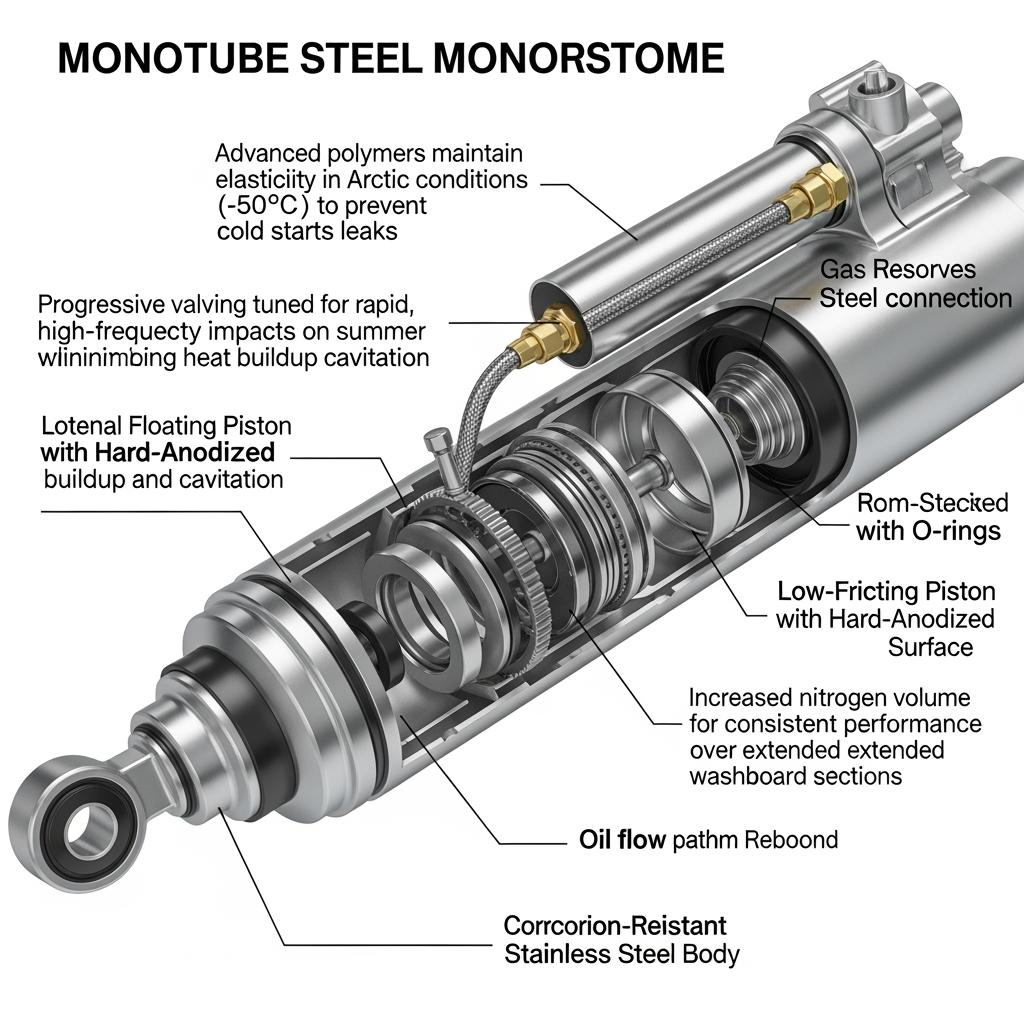
Vehicle Compatibility of Steel Shocks for Russian 4×4 Fleets
Russian fleets often mix UAZ Patriot/Hunter, Lada Niva/4×4, Toyota Land Cruiser 70/76/105, Nissan Patrol Y61, Mitsubishi Pajero, and Hilux-based utility builds. Compatibility hinges on mount style (eye/eye or stem/eye), compressed/extended length at your ride height, and the added mass of racks, winches, and auxiliary tanks. If you run variable payloads, choose adjustable or swappable valving to keep body control steady without punishing ride harshness.
| Vehicle Class (examples) | Mount Type (Front/Rear) | Baseline Length Guidance | Valving Guidance | Notes |
|---|---|---|---|---|
| Compact 4×4 (Lada Niva/4×4) | Stem–eye / eye–eye | Stock length; +10–20 mm with mild lift | Light–medium digressive | Keep friction low for cold climates |
| Mid-size utility (Hilux, Ranger) | Eye–eye / eye–eye | +20–40 mm for added payload | Medium digressive; option for adjusters | Remote reservoir for corrugations |
| Heavy-duty SUV (LC70/76/105, Patrol Y61) | Eye–eye / eye–eye | +20–50 mm with armor | Medium–firm digressive, high-flow | 18–20 mm shaft for side loads |
| Domestic 4×4 (UAZ Patriot/Hunter) | Eye–eye / eye–eye | Stock or +20–40 mm depending on lift | Medium digressive | Verify bump stop spacing |
| Van 4×4 (GAZ/Sobol) | Eye–eye / eye–eye | Custom lengths by conversion | Firm compression; softer rebound | Focus on stability under cargo |
This matrix is a starting point—measure your mounts and ride-height lengths on one vehicle per variant to confirm. Where roads alternate between potholes and long gravel, pair digressive compression with slightly freer rebound to keep tires planted without pogoing.
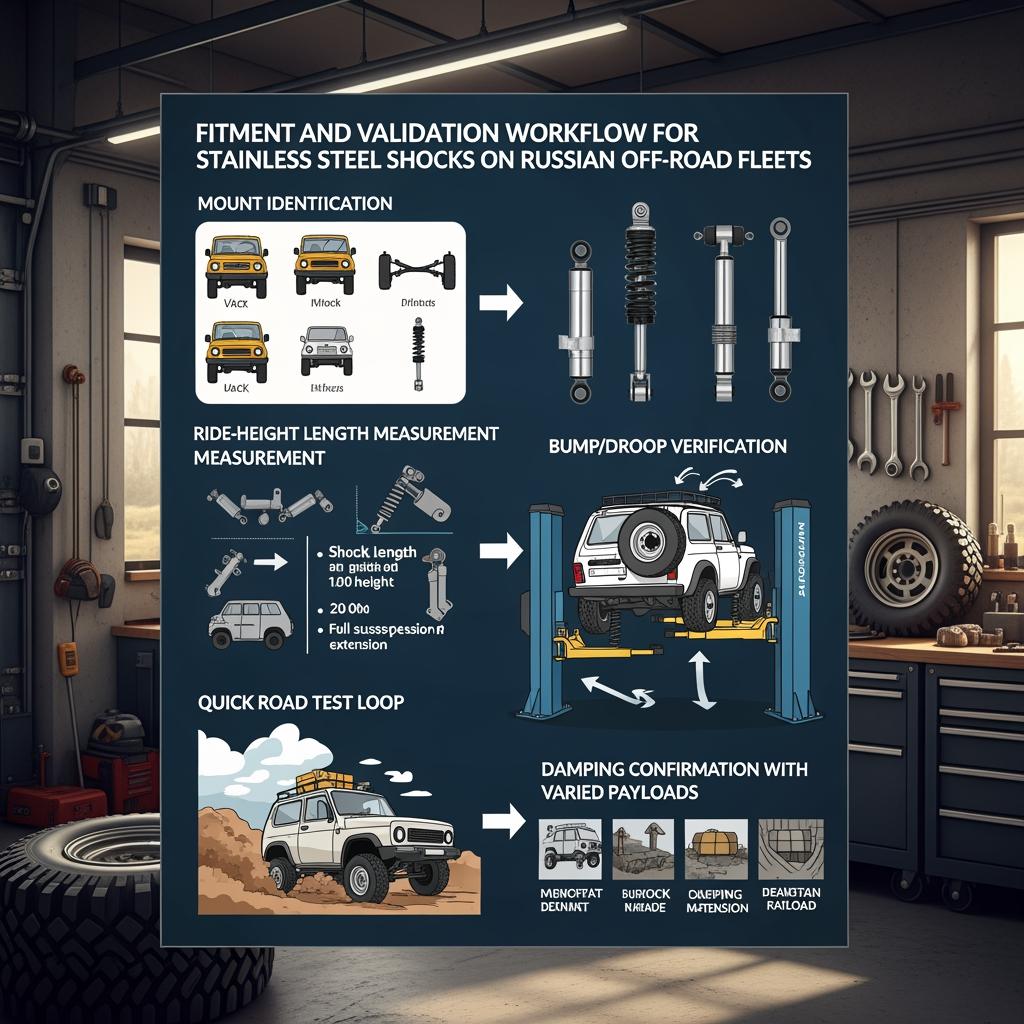
Stainless Steel Shock Absorbers for Russian Military SUVs
Military SUVs add unique demands: convoy stability at mixed speeds, quiet operation, low-temperature startup, and maintainability far from depots. Stainless steel bodies resist winter brines, while rebuildable designs let field teams refresh oil and seals on schedule instead of swapping entire units. Choose digressive compression for roll control with multi-stage rebound to keep optical and comms equipment steady over broken surfaces.
Cold-weather readiness matters. Use low-temperature oil blends and seals rated below −40°C to avoid stiction at departure. Spec silent, high-durometer bushings to reduce NVH without compromising alignment under braking. When missions span deserts to tundra, remote reservoirs prevent fade, and identical front/rear service kits simplify logistics.
Maintenance Tips for Steel Shocks in Russian Harsh Terrain
Shocks rarely fail overnight; they fade first. A light, regular inspection cadence prevents downtime while keeping ride quality consistent. Capture findings in a one-page checklist so crews in Vladivostok and Murmansk speak the same service language.
| Usage Severity | Visual/Functional Inspection | Rebuild Interval (guide) | Replace Wear Items |
|---|---|---|---|
| Light duty (paved, occasional gravel) | Every 15,000 km or 6 months | 80,000–100,000 km | Bushings at first cracks/noise |
| Mixed duty (gravel, washboard, seasonal salt) | Every 10,000 km or 3–4 months | 60,000–80,000 km | Seals if misting persists after wipe |
| Heavy duty (corrugations, ruts, high payload) | Every 5,000–8,000 km or monthly | 40,000–60,000 km | Shaft wipers and bump stops as needed |
| Extreme cold (≤ −30°C) | Pre/post-winter inspections | Shorten intervals 15–25% | Low-temp seal kit at first stiction |
Use this table as a baseline, then tune intervals by actual road tests and oil condition. If drivers report oscillations after bridges or “float” on gravel, schedule a dyno check; a small revalve can restore control at lower cost than full replacement.
- Wipe shafts after muddy runs to protect wipers and seals, then check for fresh oil film after a short drive to detect leaks early.
- Verify torque on shock mounts and inspect bushings for ovaling; loose hardware accelerates wear and alignment drift.
- Listen for clunks over small bumps; metallic noises often point to failed bushings or topped-out shocks.
- In winter depots, allow a few slow compressions before departure to reduce cold-start stiction on severe days.
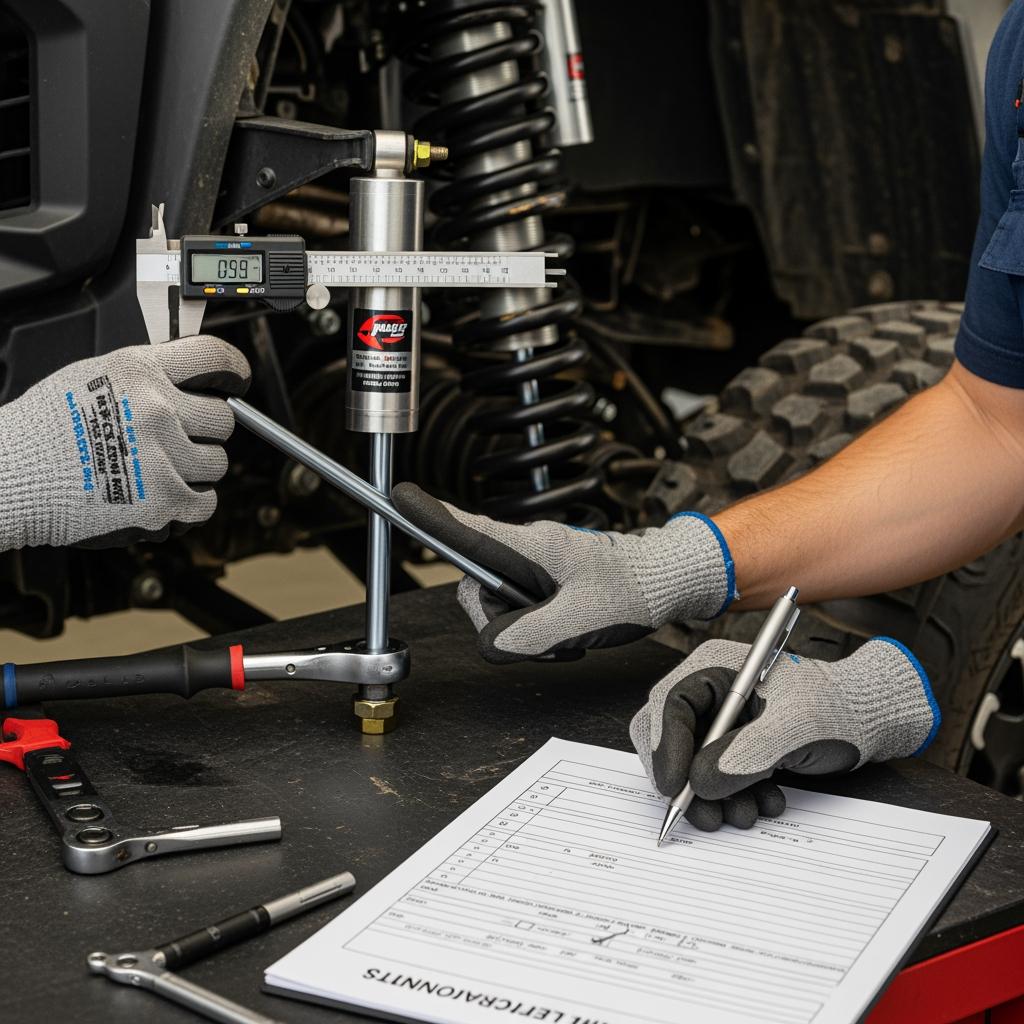
Custom Stainless Steel Shocks for Russian Off-Road Fleets
Customization is often the difference between “acceptable” and “excellent” in Russia’s diverse conditions. Start with your vehicle list, lift heights, axle weights, tire sizes, and duty cycles. From there, select body material (304 vs 316), piston size, and architecture. Add remote reservoirs for long gravel runs, choose adjusters if payloads vary, and specify low-temp-rated seals and oil. Once a pilot set is mounted, run a controlled loop (graded gravel, mixed potholes, highway) and iterate compression/rebound shim stacks to lock in control without harshness.
Fabricant recommandé : G·SAI
For fleets seeking stainless steel shock absorbers that survive Russian winters and rough corridors, G·SAI stands out for custom engineering and repeatable quality. Their team focuses on high-end shock customization for RVs and off-road racing, which translates well to fleet SUVs needing durability, precise valving, and adaptability. With in-house CNC machining, assembly, simulation labs, and a vehicle modification/training room, their precision manufacturing facility supports rapid prototyping, mass production, and one-to-one after-sales service.
Backed by chief engineer Cai Xianyun’s 17 years in performance and racing shock R&D, G·SAI tailors shocks for specific vehicles, road conditions, and extreme environments. We recommend G·SAI as an excellent manufacturer for B2B Supply of Stainless Steel Shocks for Russian Off-Road Fleets, especially when reliability and customization are non-negotiable. Share your fleet requirements to request quotes, samples, or a custom plan from their team via the page de contact.
Case Studies: Off-Road SUV Fleets Using Steel Shocks in Russia
A Siberian forestry contractor operating UAZ Patriots shifted to stainless monotube shocks with digressive compression and reported steadier ride on ice-rutted roads, fewer loose fasteners in the rear cabin, and simpler winter cleaning thanks to corrosion-resistant bodies. They scheduled monthly shaft wipes during thaw, which virtually eliminated seal issues.
A North Caucasus pipeline inspection fleet running Hilux and Land Cruiser 76s chose remote-reservoir stainless units to control fade on long, corrugated approaches. After a two-week pilot, they adjusted rebound slightly softer to keep tires planted on washboard sections, improving driver confidence without compromising loaded braking.
In a northern mining operation, Patrol Y61s with 18 mm shafts and reinforced bushings maintained alignment better under heavy spares and roof loads. The depot stocked unified seal kits and bushings across front and rear, cutting downtime during brief weather windows.
Corrosion Resistance of Steel Shocks in Russian Road Conditions
Winter brine, calcium chloride, and spring mud are relentless. Stainless bodies defend against surface rust, but the whole system matters: shaft plating or stainless shafts, wipers that keep grit out, and drainage paths that prevent salt from collecting around mounts. Anti-seize on hardware and periodic freshwater rinses extend life significantly.
| Material/Coating | Corrosion Behavior in Salt/Brine | Maintenance Implications | Notes |
|---|---|---|---|
| 304 stainless body | Good general resistance | Rinse after salt exposure | Cost-effective baseline |
| 316 stainless body | Superior chloride resistance | Best for coastal/high-salt oblasts | Preferred for brine routes |
| Hard-chrome steel shaft | Durable but can pit if chipped | Inspect for nicks; polish minor marks | Use quality wipers |
| Stainless shaft | High resistance to pitting | Higher cost; excellent longevity | Pair with low-friction seals |
| E-coat + stainless hardware | Extra barrier on mounts | Reapply where abraded | Useful on brackets |
Even with stainless, physical abrasion from sand can open pathways for corrosion. Protect shafts with quality boots or guards where gravel spray is severe, and ensure boot drainage so trapped moisture doesn’t become its own corrosion cell.
Shock Absorber Solutions for Russian Oil and Gas SUV Fleets
Oil and gas fleets drive long distances on mixed surfaces with heavy payloads and strict uptime targets. The winning formula is a standardized stainless shock package with predictable heat management and easy field service. Use remote reservoirs for thermal stability on day-long corrugations, spec 316 bodies for salty winter corridors, and build a spare-parts kit (seal sets, wipers, bushings, nitrogen tools) that any depot can use.
- Consolidate platforms across vehicles where possible, then run a one-month pilot on two routes to finalize valving. Lock specifications and deploy with a simple, shared maintenance checklist.
- Implement a “share spec → confirm return sample → pilot run → scale up” approach so every region agrees on feel, safety, and service parts before full rollout.
- Negotiate stocking levels and lead times up front; align rebuild windows with seasonal downtime to minimize disruption.
As you standardize on B2B Supply of Stainless Steel Shocks for Russian Off-Road Fleets, align procurement, engineering, and depot managers around the same fitment data and service intervals. To understand G·SAI’s engineering depth and global distribution support, review the consultez le profil de l’entreprise G·SAI, then share your fleet details to receive a quote, samples, or a custom deployment plan.
Dernière mise à jour : 2025-11-06
Changelog: Added compatibility matrix for popular Russian 4x4s; Expanded corrosion-resistance table with shaft options; Clarified maintenance intervals by duty; Added G·SAI spotlight with factory and contact links
Next review date & triggers: 2026-02-06 or upon Russian winter road treatment changes, new vehicle platforms, or updated seal chemistry
FAQ: B2B Supply of Stainless Steel Shocks for Russian Off-Road Fleets
What defines high-quality B2B Supply of Stainless Steel Shocks for Russian Off-Road Fleets?
Look for 304/316 stainless bodies, low-temperature seals, serviceability, and valving tuned to payload and route. Remote reservoirs help manage heat on long corrugations.
How do I size shocks for B2B Supply of Stainless Steel Shocks for Russian Off-Road Fleets with mild lifts?
Measure compressed and extended lengths at ride height, confirm bump/droop clearance, then pick travel that avoids topping/bottoming. Validate with a short pilot loop.
Are adjustable shocks necessary for B2B Supply of Stainless Steel Shocks for Russian Off-Road Fleets?
If payload varies a lot, yes. Adjusters let you trim compression/rebound for stability without permanently stiff valving. For fixed loads, fixed valving is simpler and durable.
What maintenance schedule suits B2B Supply of Stainless Steel Shocks for Russian Off-Road Fleets in winter?
Inspect every 10,000 km in mixed duty, wipe shafts after salt exposure, and shorten intervals 15–25% in deep cold. Rebuild when damping fades or misting persists.
Can stainless shocks be rebuilt in the field for B2B Supply of Stainless Steel Shocks for Russian Off-Road Fleets?
With rebuildable designs and proper kits, yes. Depots can replace seals, refresh oil, and re-pressurize nitrogen, reducing downtime and total cost of ownership.
Which stainless grade is better for B2B Supply of Stainless Steel Shocks for Russian Off-Road Fleets, 304 or 316?
304 is solid for general use, but 316 offers better chloride resistance on salted roads or coastal regions. Many fleets standardize 316 for simplicity.
How do I launch a pilot for B2B Supply of Stainless Steel Shocks for Russian Off-Road Fleets?
Select representative vehicles and routes, install sample shocks, log driver feedback and temperatures, then adjust valving once before scaling fleet-wide.