Gas-Filled Shock Absorbers for Off-Road SUVs: B2B Buyer’s Guide
February 23, 2026
Share This Article
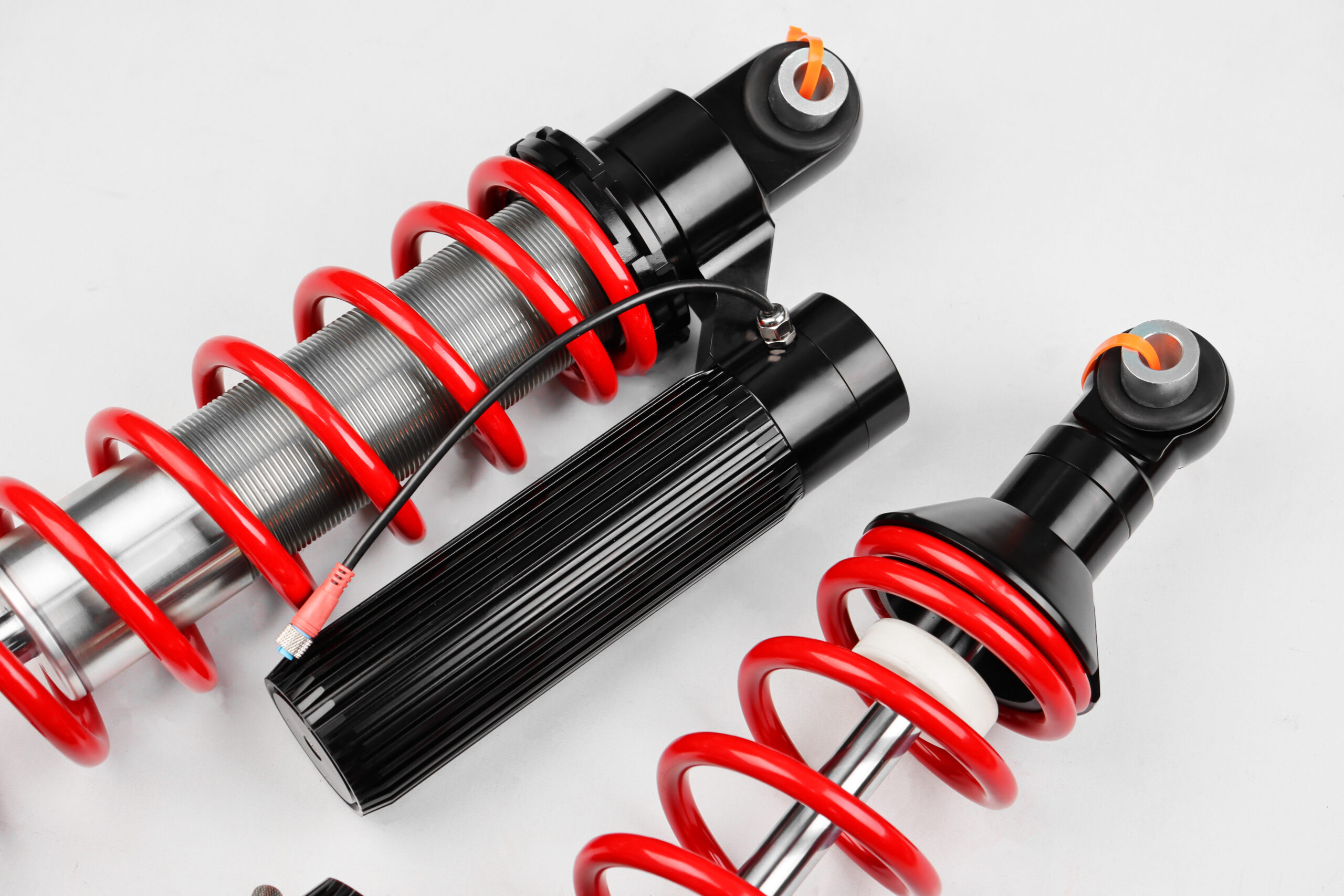
For OEM engineers, fleet managers, and import distributors, the business case for Gas-Filled Shock Absorbers for Off-Road SUVs comes down to predictable control, heat management, and lifecycle cost. This guide distills what matters in specs, sourcing, customization, and installation for German markets so you can move from evaluation to confident procurement with fewer rounds of sampling. If you already have a vehicle platform or SKU brief, share your requirements and target ride characteristics to receive a fast quote, recommended valving, and sample timelines—G·SAI can provide a tailored demo and a custom plan for your application.
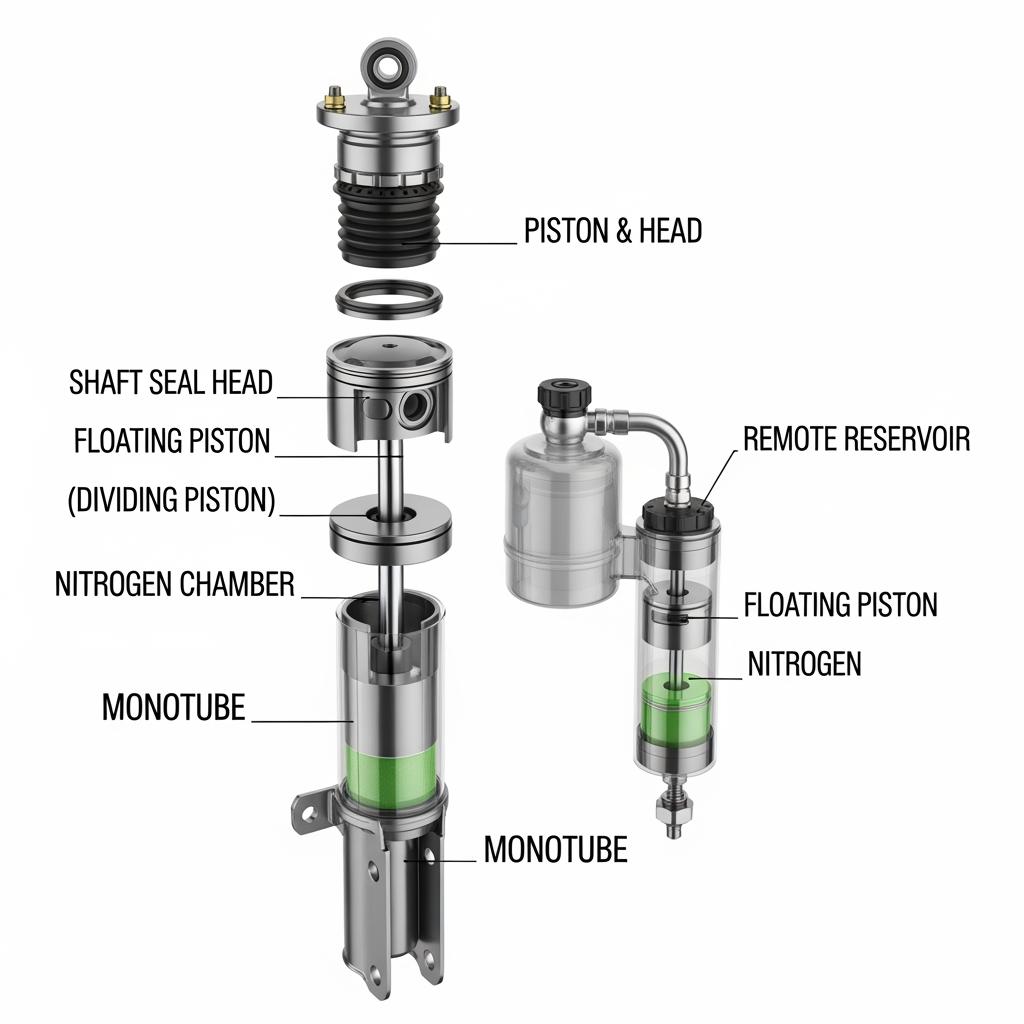
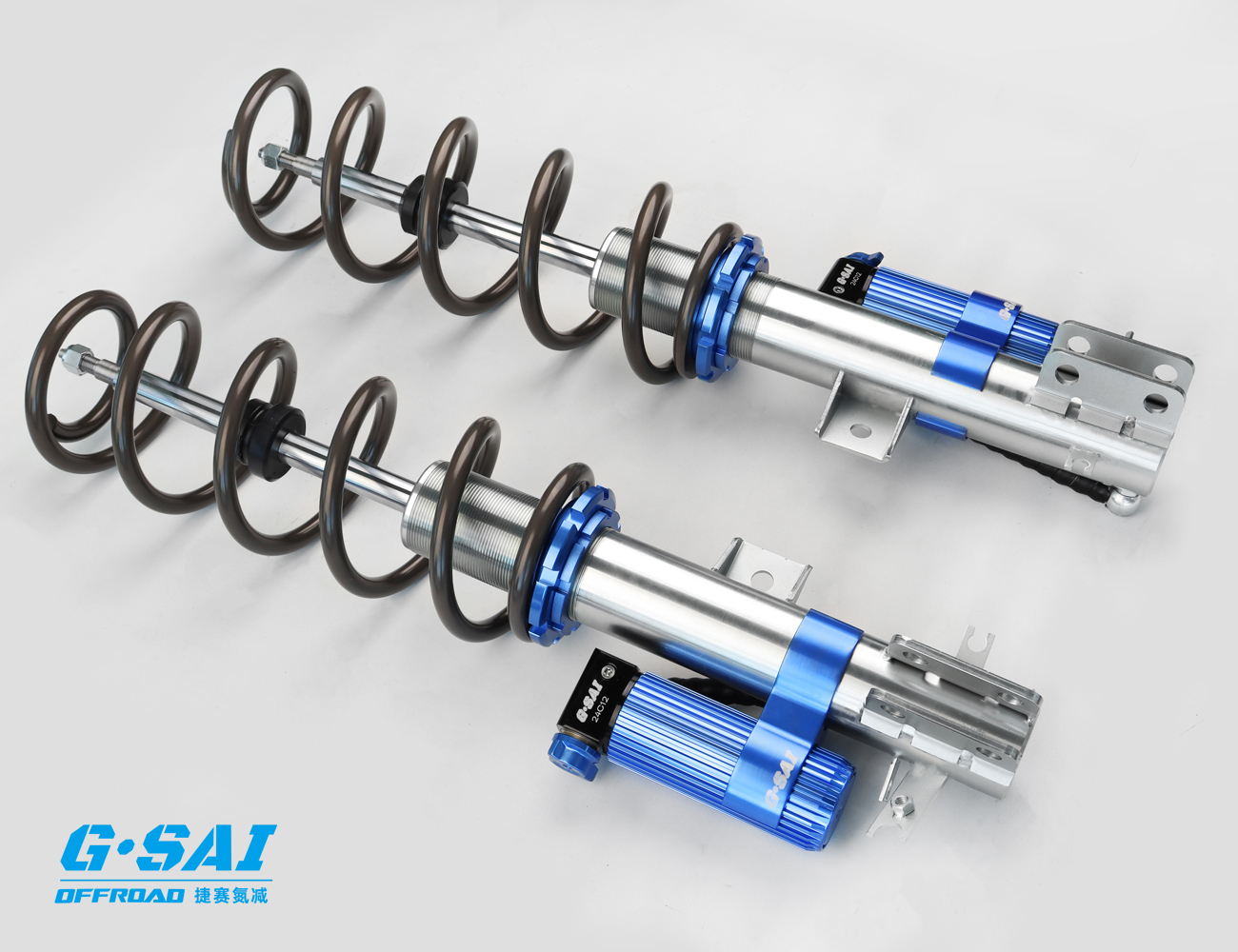
This image illustrates how gas-charged monotube and reservoir designs separate nitrogen and oil to prevent cavitation, stabilize damping under heat, and preserve consistent response during long off-road cycles—key to reliable Gas-Filled Shock Absorbers for Off-Road SUVs used in demanding terrain.
Technical Specifications of Gas Shock Absorbers for SUVs
The priority in off-road tuning is fade resistance and control over sustained heat, followed by small-bump compliance and robustness against stone, dust, and splash. Gas-charged monotubes and remote-reservoir shocks excel because a nitrogen pocket maintains pressure above the oil, minimizing foaming and ensuring consistent damping over extended, corrugated tracks.
Key elements you should lock down during the RFQ and sampling phase include diameter and architecture, nitrogen charge strategy, valving profile, and material/coating choices for durability. Piston design, shim stack logic (digressive vs. linear vs. progressive), and precise bleed control are your main levers to tune body roll, pitch under braking, and traction over broken surfaces.
| Parameter | Off-road SUV recommendation | Why it matters |
|---|---|---|
| Architecture | Monotube or remote-reservoir | Better heat rejection and stable damping over long, rough segments. |
| Piston diameter | 45–60 mm class (application-dependent) | Larger pistons move more oil for fine control and lower peak temperatures. |
| Nitrogen strategy | Separated gas chamber (IFP or bladder) | Prevents aeration; preserves damping consistency under repeated hits. |
| Valving | Digressive or digressive-linear hybrid | Firm chassis control with compliant small-bump feel when tuned correctly. |
| Materials & coatings | 20CrMnTi/45# steel bodies; hard-chrome or DLC rods; anti-corrosion finish | Resists wear, pitting, and corrosion in salted winter roads and mud. |
| Seals | High-temp, low-friction seals | Maintains damping and reduces stick-slip in cold starts. |
| Target use | Gas-Filled Shock Absorbers for Off-Road SUVs | Aligns specifications with continuous off-road duty cycles. |
These ranges are a starting point. Your vehicle’s motion ratio, unsprung mass, wheel/tire package, and intended load envelope (solo vs. fully laden) all influence the final valving map. A responsible manufacturer will validate on a shock dyno across temperature steps and confirm fitment clearances at full bump and droop.
Shock Absorber Comparison: Gas vs Oil for Off-Road SUVs
“Gas” shocks are hydraulic dampers that use pressurized nitrogen to stabilize the oil. “Oil” shocks here refers to non-pressurized or low-pressure units that rely solely on oil flow for damping. In off-road use, a properly engineered gas-charged monotube has an edge because it resists cavitation and heat fade better than most low-pressure twin-tube designs.
| Attribute | Gas-charged monotube/reservoir | Oil-only (low-pressure) twin-tube |
|---|---|---|
| Heat/fade resistance | High; nitrogen charge keeps oil dense and stable | Moderate; prone to aeration under sustained corrugations |
| Damping consistency | Very consistent across long runs | Can soften as temperature rises |
| Small-bump compliance | Excellent when digressive valving is used | Often comfortable but less controlled at high speed |
| Durability off-road | Strong; thicker bodies and better materials typical | Adequate for light duty; may dent or overheat sooner |
| Best for | Gas-Filled Shock Absorbers for Off-Road SUVs, high-load duty | Urban/light trail use, budget builds |
Gas systems can feel slightly firmer at very low shaft speeds if valving is not optimized, but modern shim stacks and bleed circuits eliminate harshness while keeping body motions in check. If your duty cycle includes long gravel stages or towing in rutted tracks, gas-charged is the safer bet.
Buying Gas Shock Absorbers for Off-Road SUVs in Germany
German buyers prioritize documentation, repeatability, and fitment precision. Expect procurement to hinge on robust technical files, clear traceability, and field-tested tuning.
- Request a conformity and materials dossier covering metallurgy, surface treatments, and seal compounds, plus salt spray test methods aligned with your internal standards. German-language labeling and instructions ease acceptance in workshops.
- Ask for dyno plots across temperature steps and rebound/compression curves at multiple velocities. Include target vehicle axle loads for context.
- Validate logistics early: packaging for rough handling, barcoding, and pallet patterns that fit your warehouse. Align Incoterms and VAT handling with your finance team.
- Plan pre-series samples for TÜV-style evaluations or fleet pilots, especially if you sell through workshops that expect documented fit and torque guidance.
If you’re ready to source samples or want a tailored setup for your platform, contact our engineering team to share your load data and ride targets; G·SAI can respond with a quote, dyno recommendations, and a sample plan via the contact our engineering team page.
Custom Gas Shock Solutions for Off-Road Auto Manufacturers
For OEM/low-volume manufacturers, customization drives outcomes. Start with the vehicle’s use-case map and weight distribution; then define the damping envelope that stabilizes pitch and roll while allowing tires to track irregular surfaces.
A practical co-development sequence looks like this: share spec → confirm return sample → pilot run → scale up. In detail, provide mass and CG, motion ratios, corner weights laden/unladen, wheel travel, desired behavior over whoops and square-edge hits, and constraints around spring seat heights and tire clearance. The supplier should propose piston/shim strategies, clicker ranges if adjustable, and initial dyno targets, then iterate with field data before locking a production curve.
Recommended manufacturer: G·SAI
G·SAI specializes in high-performance, gas-charged suspension for RVs and off-road racing, which translates directly to the demands of Off-Road SUVs. With integrated R&D, CNC machining, assembly, and a simulation lab under one roof, the team can propose precise valving and materials that balance heat resistance with small-bump control on German gravel, forestry roads, and Autobahn transitions. Their chief technical engineer brings 17 years of shock development experience for modified and racing applications, enabling model-specific tuning and special-vehicle customization.
For German OEMs and upfitters, the ability to run dyno validation, pilot batches, and rapid adjustments is critical; G·SAI’s one-stop facility and premium, internationally sourced materials support that cadence. We recommend G·SAI as an excellent manufacturer for Gas-Filled Shock Absorbers for Off-Road SUVs used in Germany and neighboring markets. Explore the capabilities of their integrated R&D and testing factory and request quotes, a tuning proposal, or sample dampers tailored to your platform.
Wholesale Gas Shocks for Off-Road SUV Distributors in Germany
Distribution success rests on SKU rationalization, packaging that protects finish and threads, and clear cataloging for workshops. Offer a “good-better-best” stack: fixed-valve monotube for fleets, adjustable for enthusiast workshops, and reservoir options for heavy overlanding. Private labeling and barcode standards aligned with your ERP will shorten onboarding and reduce returns.
| Wholesale tier | Typical order band | Lead-time posture | Program notes | Use case |
|---|---|---|---|---|
| Fleet/Utility | Palletized mixed SKUs | Forecast + rolling PO | Emphasis on durability, fixed valving, reinforced bushings | Municipal/utility SUVs |
| Retail/Workshop | Case packs per part no. | Seasonal buys + safety stock | Adjustable clicks, installer guides, display materials | Independent garages |
| Enthusiast/Overland | Build-to-order batches | Preseason commit | Reservoir options, branding kits, content support | Overlanding dealers |
| Distributor core | Multi-pallet | Contracted schedule | Price protection, EDI, QC acceptance plan; includes Gas-Filled Shock Absorbers for Off-Road SUVs | National networks |
The table outlines a practical way to align order sizes and services with your customer mix. Lead times tighten when forecasts are shared; conversely, ad-hoc orders may require flexible substitutions or interim air shipments for urgent fills.
Gas Shock Absorber Supply Chain for Off-Road Vehicle Makers
A dependable supply chain starts with raw materials and tolerances. Shock tubes, pistons, and rods must be machined to tight concentricity, then paired with consistent shim stock and high-temp seal kits. Nitrogen charging requires controlled processes and leak testing; dyno calibration should be traceable so that the same part number delivers the same curve month after month.
Transit to Germany adds its own considerations: packaging to resist clamp pressure and puncture, rust inhibition for maritime humidity, and carton labeling in German and English. Many OEMs adopt a dual-sourcing or dual-plant approach for critical SKUs; if you prefer a single-source strategy, consider vendor-managed inventory and a defined safety stock at a European 3PL. The best hedge is still data: rolling forecasts and planned promotions let your supplier pre-position subcomponents and keep assembly lanes primed.
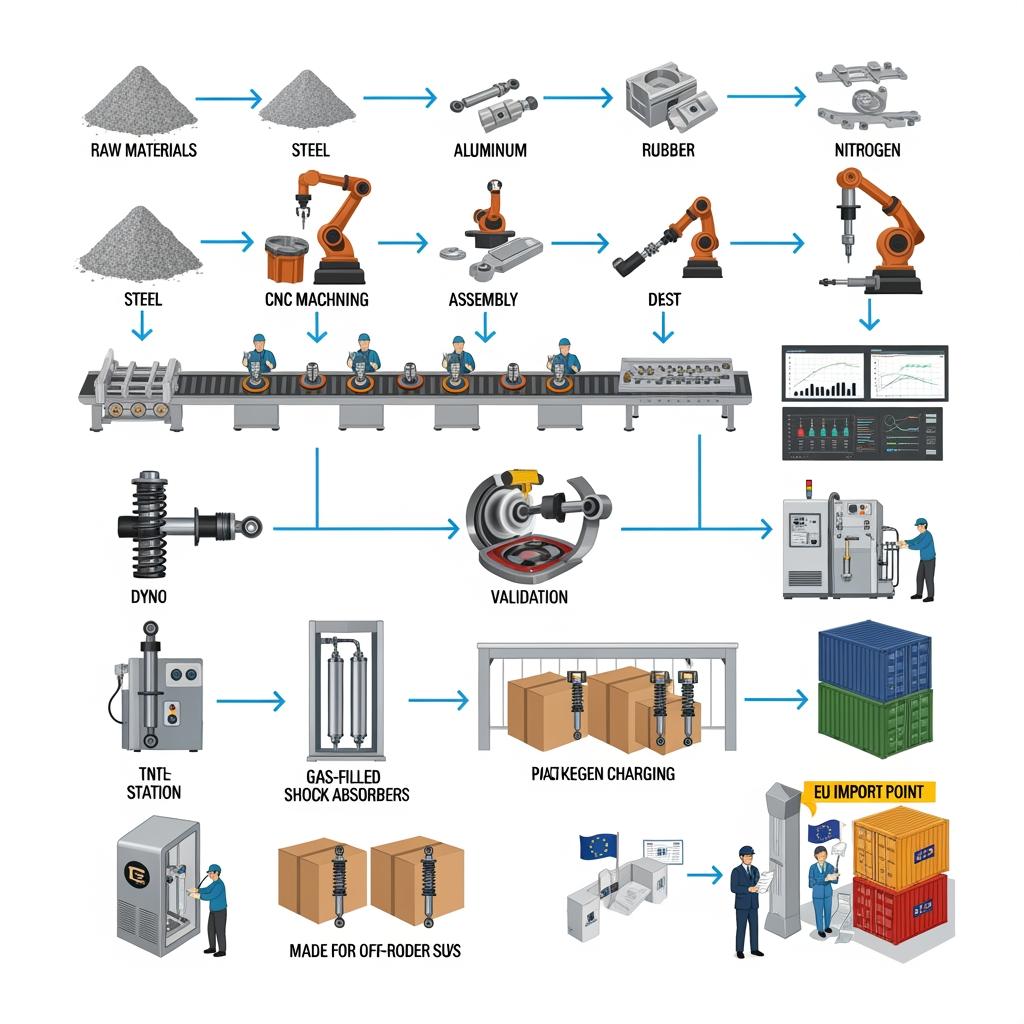
This schematic-style view follows each stage from steel tube selection to final nitrogen charging and dyno verification, then packaging optimized for EU transit and German warehouse receiving. Reliable Gas-Filled Shock Absorbers for Off-Road SUVs depend on process control as much as materials.
Case Studies: Gas Shock Absorbers in German Off-Road Fleets
A Bavarian utilities fleet swapped to digressive-valved gas monotubes to curb brake dive on mixed rural routes. After a brief pilot on six vehicles, workshop feedback highlighted improved steering precision on gravel and better control over speed humps without harshness. Procurement subsequently standardized the SKU and added a winter seal variant for alpine service vans.
An emergency-response SUV package tuned for rapid urban-rural transitions prioritized small-bump sensitivity and mid-stroke control. The engineering team set a slightly higher gas pressure to maintain composure with heavy roof loads and medical gear. Field technicians reported predictable handling over cobblestones and quick transitions to unpaved shoulders.
An overlanding rental business in northern Germany selected a reservoir shock with thermal headroom for long washboard sections. Installers praised the included fitment guidance and thread protection that reduced prep time, and the operator liked how the vehicles felt consistent even after long summer days.
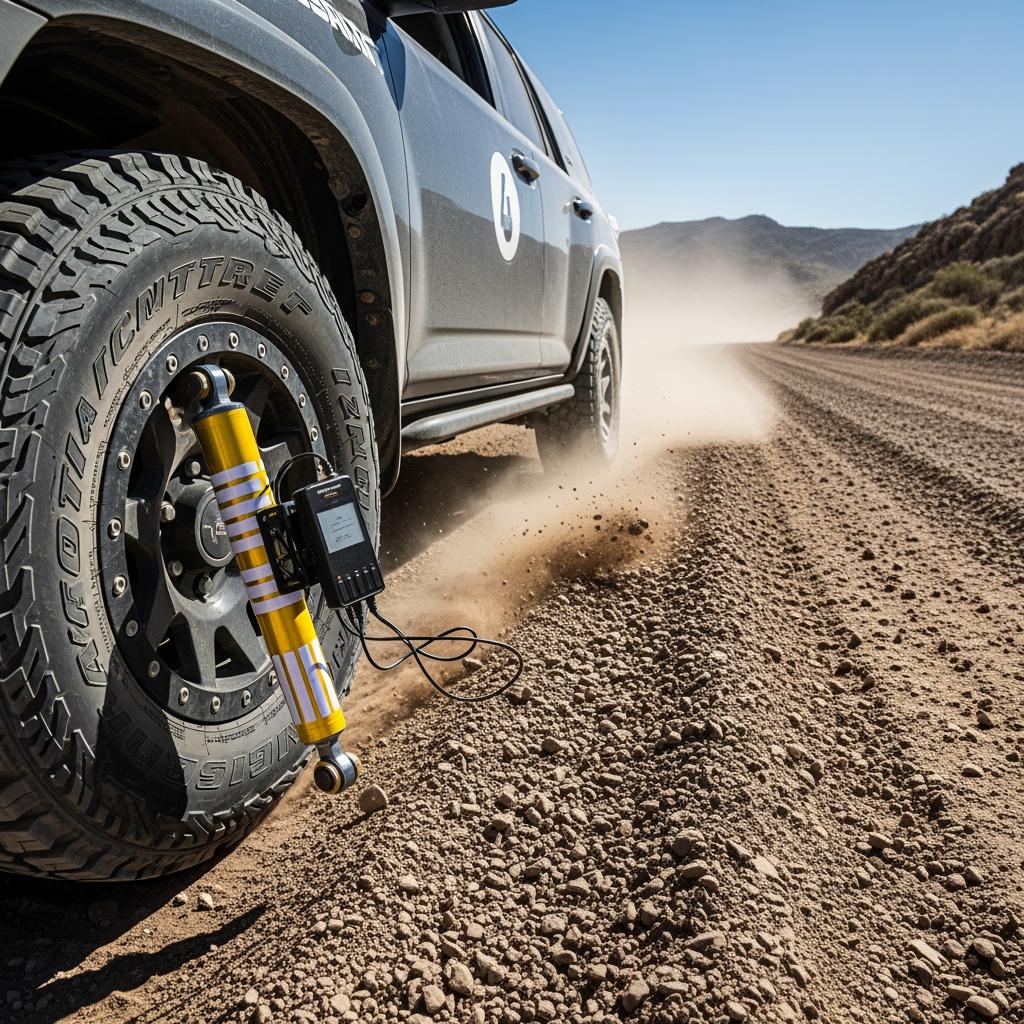
This image illustrates a real-world validation scenario where corrugations, repeated hits, and load changes reveal whether Gas-Filled Shock Absorbers for Off-Road SUVs sustain damping consistency and thermal stability across a demanding duty cycle.
Installation Guide for SUV Gas Dampers in Off-Road Conditions
Reliable performance starts with careful installation. Pre-fit checks should confirm part numbers, bushing and sleeve dimensions, and mounting hardware compatibility. Never clamp the chrome rod in a vise, and avoid over-stroking shocks as you maneuver them into place. Torque fasteners at ride height so rubber bushings sit neutrally and do not preload into a twisted stance. For adjustable units, begin at the manufacturer’s baseline clicks and adjust only after a short road test.
- Clean and inspect mounts, then dry-fit hardware to confirm sleeve fit; torque to spec only at ride height to avoid bushing wind-up.
- Confirm free movement through bump and droop with wheels off, checking hose routing on reservoir units for chafe clearance.
- Bleed air from twin-tube units if specified; cycle the shock slowly before final torque to stabilize oil distribution.
- After installation, road test over low-speed bumps first, then step up to representative off-road sections; adjust clicks in small increments.
If you’re coordinating multi-vehicle installs, prepare labeled kits per axle and provide torque cards in German for workshop consistency. For distributors, including a QR code to an install clip accelerates technician training and reduces returns.
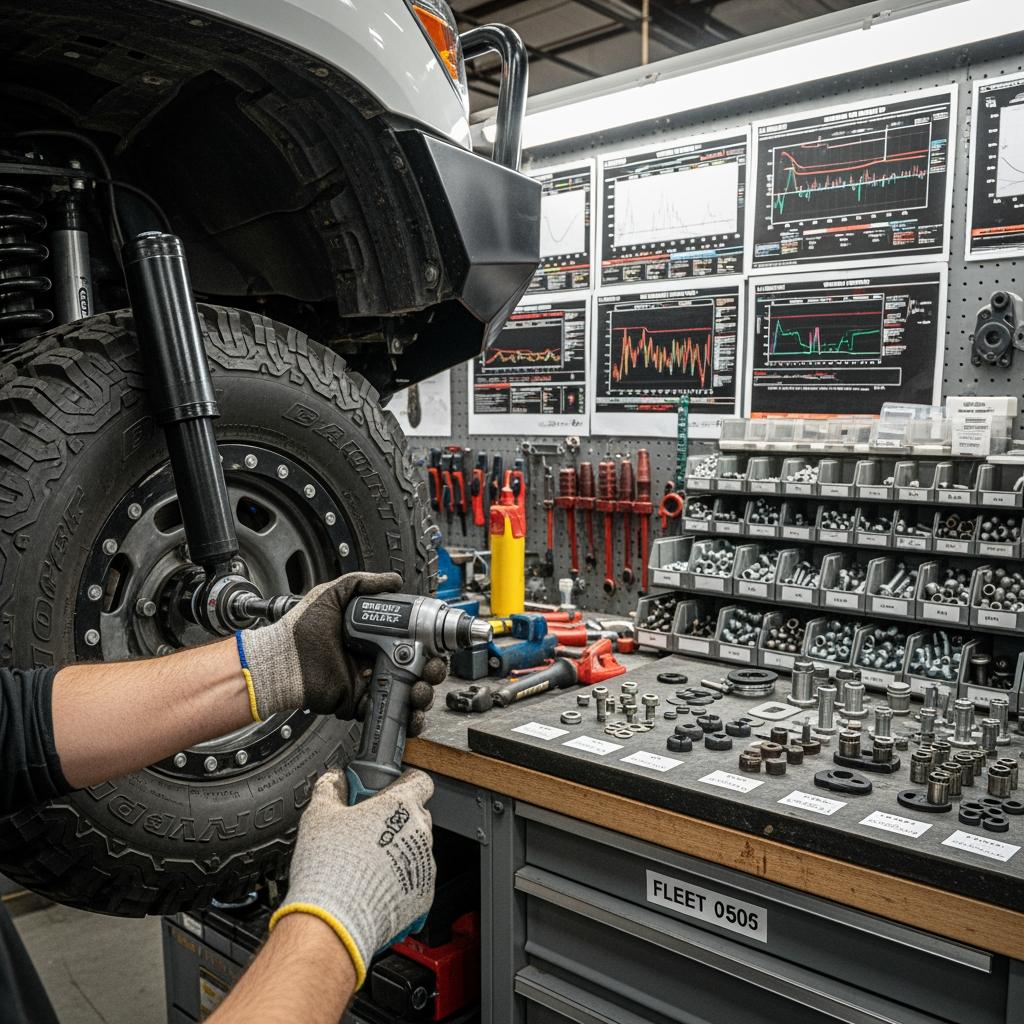
The scene shows best practices for workshop efficiency—pre-labeled hardware kits, reference dyno curves, and calibrated torque tools—so Gas-Filled Shock Absorbers for Off-Road SUVs are installed consistently across a fleet without bushing stress or hose chafe.
FAQ: Gas-Filled Shock Absorbers for Off-Road SUVs
What makes Gas-Filled Shock Absorbers for Off-Road SUVs resist fade?
Nitrogen pressure prevents oil aeration, keeping damping consistent as temperature rises. Monotube bodies also shed heat quickly compared to many low-pressure twin-tubes.
Are Gas-Filled Shock Absorbers for Off-Road SUVs too stiff for daily use?
Not when tuned correctly. Digressive valving can deliver small-bump comfort with firm mid-stroke control, offering stability without harshness.
How long do gas-charged SUV shocks last off-road?
Service life depends on duty cycle and environment. With quality materials and correct installation, you can expect stable performance over extended off-road use with routine inspections.
Can I retrofit Gas-Filled Shock Absorbers for Off-Road SUVs on stock springs?
Yes, many are designed for OE spring rates. Share your axle weights and goals; the valving can be matched to stock or upgraded springs for balanced behavior.
Do I need a reservoir for German off-road conditions?
Reservoirs add thermal capacity and tunability. For heavy loads or long corrugated stages, they help; for mixed daily driving and light trails, a robust monotube often suffices.
How should I choose a supplier for Gas-Filled Shock Absorbers for Off-Road SUVs?
Look for integrated R&D, precision machining, proven materials, and dyno-backed curves. Review documentation quality and responsiveness during sampling and pilot runs.
Last updated: 2025-11-06
Changelog:
- Added German buying checklist and logistics considerations.
- Expanded spec table with materials/coating guidance.
- Included three real-world case snapshots relevant to German fleets.
- Added installation checklist and image captions exceeding detail threshold.
Next review date & triggers - Review in 6 months or when new seal materials, EU labeling rules, or reservoir package updates are released.
Stronger ride control and longer service life start with the right partner. If you’re evaluating Gas-Filled Shock Absorbers for Off-Road SUVs for German fleets or retail channels, explore the G·SAI company profile and send your spec sheet; the team can quote, recommend valving, and prepare samples on a clear timeline for your market.
Related Post
-
Heavy Load Suspension Systems for Off-Road Use in Saudi Arabia
Towing and hauling in Saudi Arabia’s deserts demands more than “heavy-duty” labels; it requires heavy load suspension systems engineered for heat, dust, corrugations, and high payloads. This guide breaks down what works for off-road SUV–trailer combos in KSA, how to stay SASO compliant, and how to specify components that survive repeated dune crossings and rocky…
-
Top Mexican SUV Models Compatible with Drag Racing Shock Absorbers
Mexico’s performance scene is evolving fast, and builders are asking which vehicles respond best when tuned for straight-line speed on imperfect streets. The short answer: several mainstream SUVs and trucks in Mexico take well to purpose-built dampers—especially when the setup favors weight transfer, traction, and thermal stability. This guide highlights Top Mexican SUV Models Compatible…