How to Choose Adjustable Shock Absorbers for Thai Terrain
October 31, 2025
Share This Article
Choosing adjustable shock absorbers for Thai terrain starts with a clear picture of where you drive most: steep Northern mountain switchbacks, clay-heavy jungle mud, coastal sand, or Bangkok’s speed bumps and broken tarmac. The right shocks balance control, comfort, load support, and corrosion resistance while staying compliant with local rules. If you’re ready to cut guesswork, share your SUV model, payload, and routes and we’ll turn that into a custom recommendation; you can also contact the G·SAI team to request a quote or demo setup via contact the G·SAI team.
Off-Road Suspension Kits for SUVs in Thailand’s Mountain Terrain
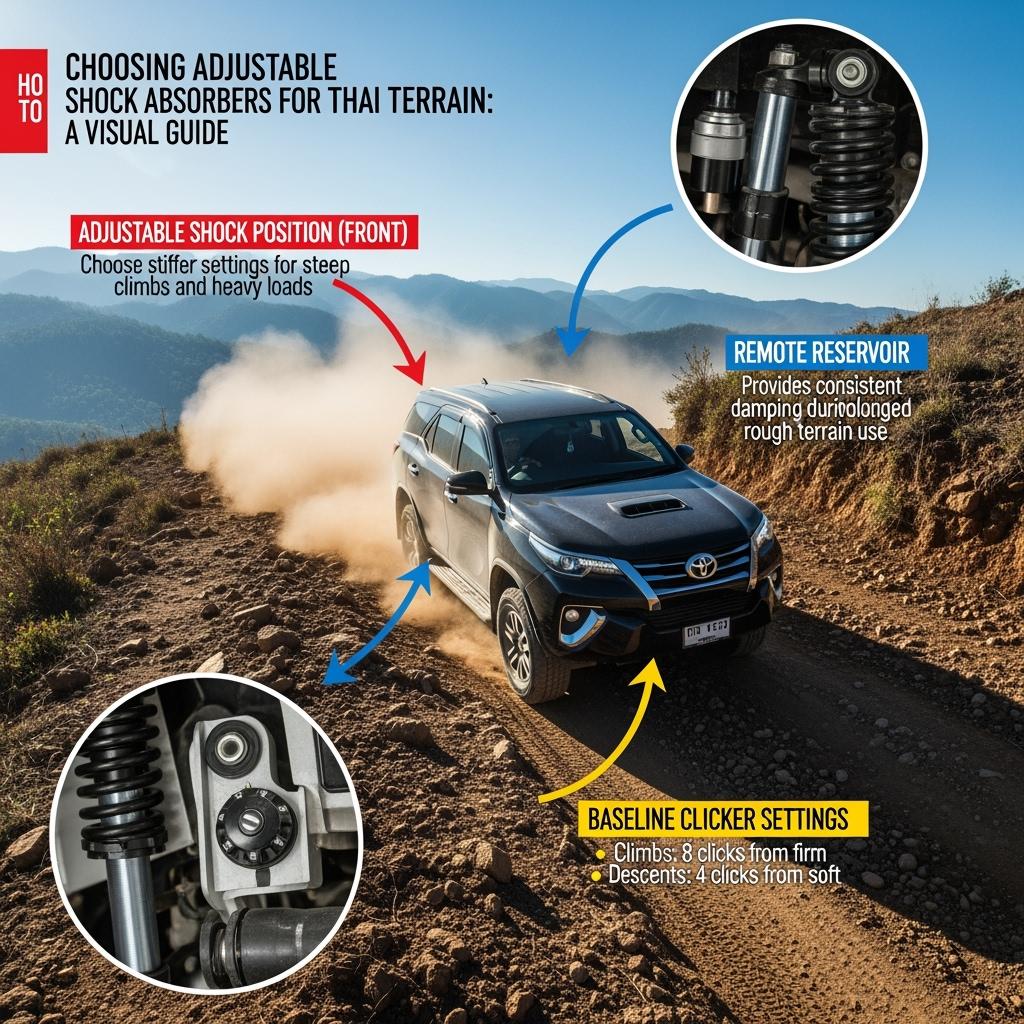
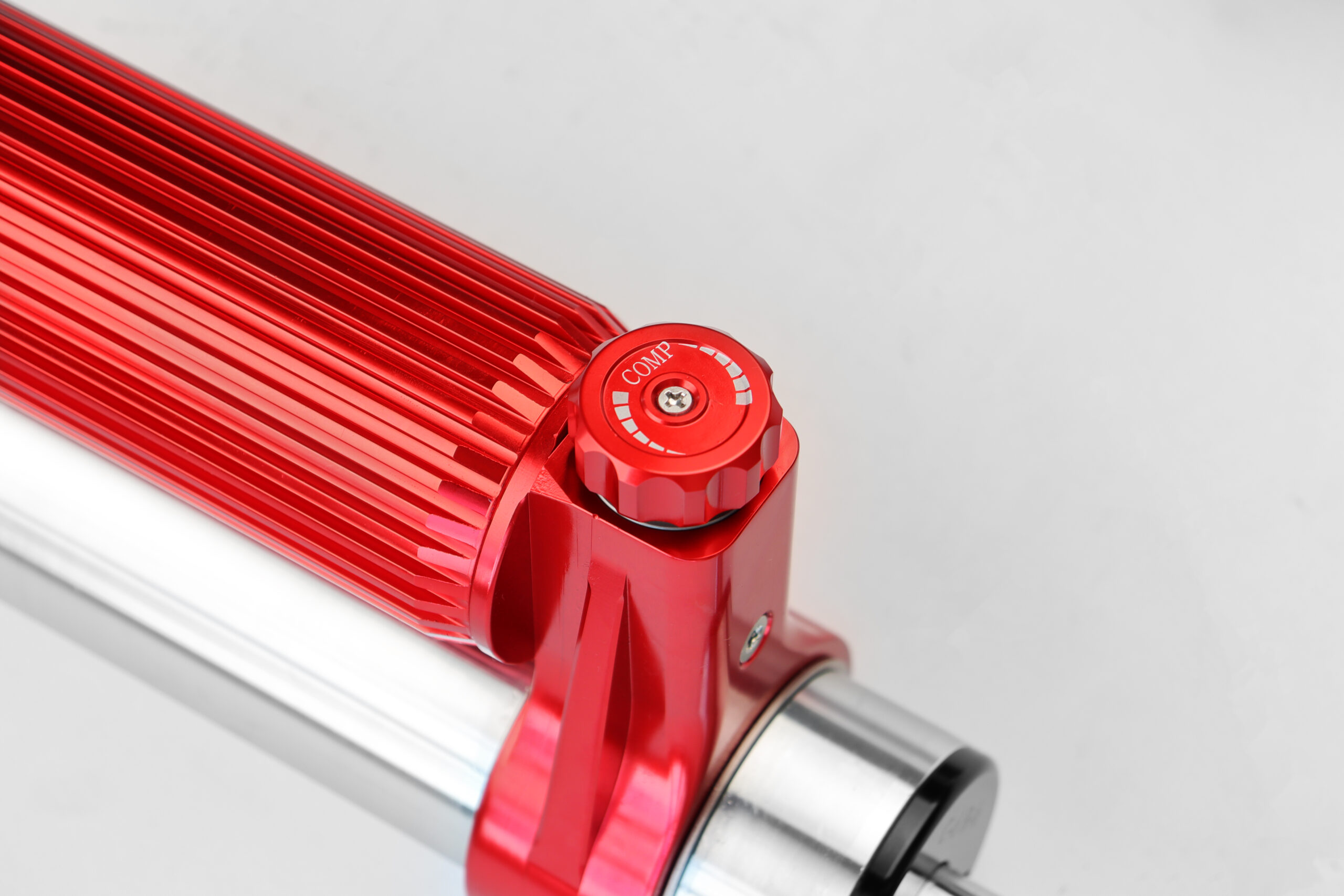
Thai mountain terrain mixes sharp elevation gains, off-camber turns, washboard sections, and embedded rock. For safe, fast progress with minimal brake fade and body roll, prioritize a monotube design with remote reservoirs for thermal stability, adjustable high- and low-speed compression for cornering control, and rebound adjustment to manage weight transfer on descents. Progressive-rate front coils improve initial compliance over chatter, while slightly stiffer rear springs protect against bottoming when carrying recovery gear or water.
On steep climbs, add a touch more low-speed compression to hold the front up under throttle; on long descents, increase rebound to slow spring return and stabilize the chassis. Pair with reinforced upper control arms for alignment at +40–50 mm lift, travel-friendly bump stops, and braided lines. Keep ride height conservative to preserve CV angles and brake line slack.
Mountain kit selection matrix (baseline starting points)
| Thai SUV model segment | Front spring rate baseline | Rear spring rate baseline | Shock adjuster baseline | Notes | Guidance reference |
|---|---|---|---|---|---|
| Mid-size (Fortuner/Everest class) | 650–700 lb/in | 200–300 lb/in + helper | C: 6–8 clicks, R: 5–7 | Remote reservoir preferred for heat | How to Choose Adjustable Shock Absorbers for Thai Terrain |
| Body-on-frame 7-seat | 600–650 lb/in | 250–350 lb/in | C: 5–7, R: 6–8 | Add jounce bump stops for rock steps | — |
| Light-duty 4×4 (Terra/MU-X class) | 550–600 lb/in | 200–300 lb/in | C: 4–6, R: 4–6 | Keep lift ≤50 mm for geometry | — |
These baselines keep damping in the mid-range to leave room for on-trail tuning. The primary key is heat control; remote reservoirs and quality fluid maintain consistent damping on long descents and in humid conditions.
Best Adjustable Shocks for 4×4 SUVs on Thai Mud Roads
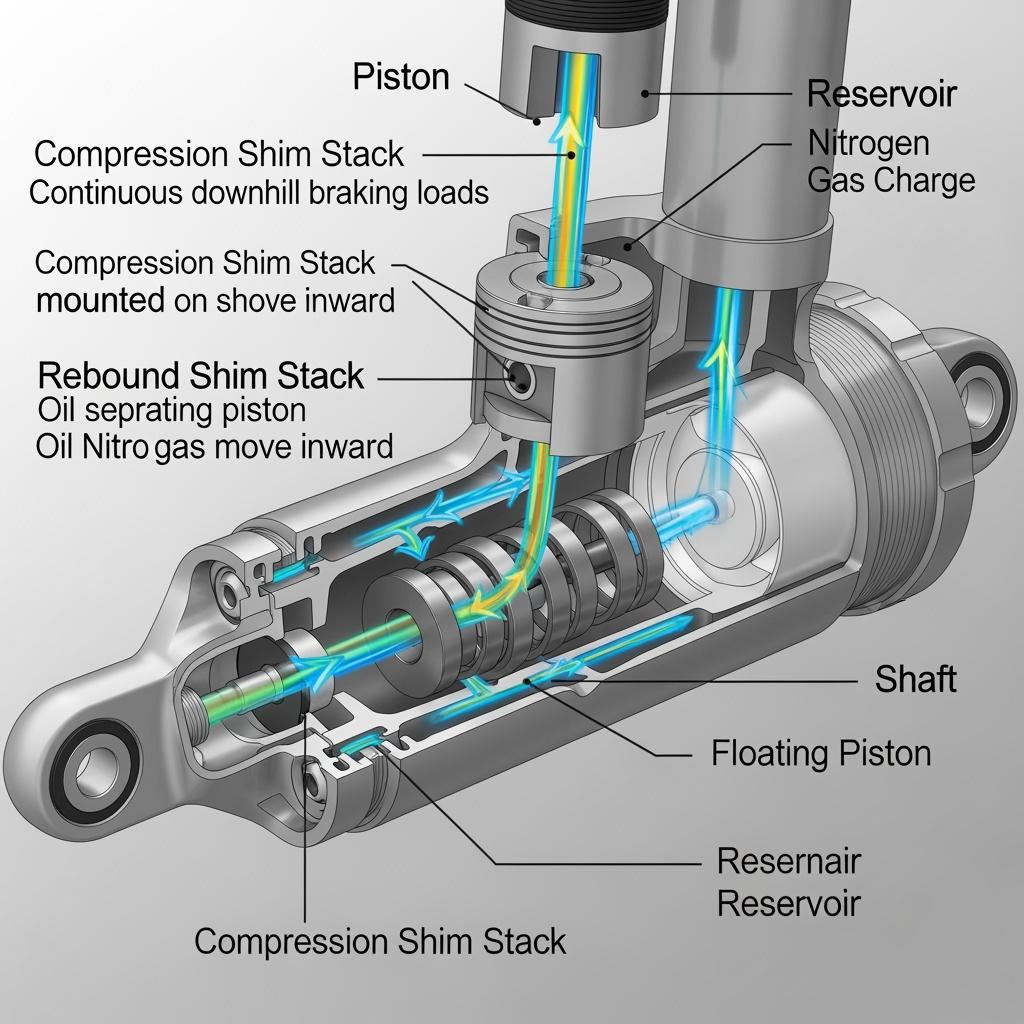
Jungle mud in Thailand can be saturated, clay-rich, and rutted. Traction comes and goes, making chassis balance critical. Digressive piston profiles help hold the body flat at low shaft speeds in off-camber ruts, while linear or mildly progressive valving improves compliance as speeds increase along plantation roads.
For longevity, prioritize multi-lip wiper seals, mud-shedding coil wraps, hard-anodized bodies, and stainless hardware. A small rebound bias improves traction by preventing the wheel from skipping when grip returns. Consider a moderate lift (20–40 mm) to clear rut edges without raising the center of gravity too much. If you run snorkels and do water crossings, choose shocks with corrosion-resistant coatings and drainage-friendly lower mounts.
On deep clay, reduce low-speed compression a couple of clicks to let tires follow the surface, and add one rebound click to calm chassis “spring-back” as you exit ruts.
SUV Shock Absorber Performance in Thailand’s Rainy Season
Rain transforms much of Thailand’s backcountry, and even paved roads can develop potholes and standing water. Adjustable shocks help you match damping to the day’s conditions. As temperatures drop during monsoons, oil viscosity rises slightly; a click or two more compression can restore body control, while careful rebound tuning keeps tires planted when crossing broken asphalt edges.
Protect hardware with frequent rinsing, especially after brackish water crossings. Torque-check top hats and lower mounts after the first 500 km of wet-season driving, then every 2,000 km. A hydrophilic film on shock shafts can attract grit; keep dust boots in good condition.
- Common rainy-season mistakes to avoid: over-stiff rebound that causes skittering on wet patches; too little compression that allows bottoming into potholes; skipping post-crossing rinses that accelerate corrosion; and overlooking alignment checks after repeated pothole hits.
Comparison of Adjustable Shocks for Thai SUV Models
Different Thai-market SUVs need different tuning corridors due to weight distribution, suspension geometry, and intended payloads. Use the table as a fitment and setup compass, then fine-tune by terrain and load.
| Thai SUV model (typical) | Fitment style | Travel gain target | Spring rate corridor | Adjustability channels | Notes for Thai terrain |
|---|---|---|---|---|---|
| Toyota Fortuner | Direct bolt-on, UCA optional @ 50 mm | +10–20% | 600–700 lb/in front, 250–350 lb/in rear | Compression + rebound (independent) | Strong front-end support reduces nose-dive on steep descents |
| Ford Everest | Bolt-on; sway-bar links advised | +10–15% | 600–650 / 250–300 | Compression + rebound | Slight rebound bias helps over corrugations on plantation roads |
| Isuzu MU-X | Bolt-on; add bump stops for load | +10–15% | 550–650 / 200–300 | Compression + rebound | Keep lift ≤40 mm to preserve driveline angles |
| Mitsubishi Pajero Sport | Bolt-on; rear load support key | +10–15% | 600–650 / 250–350 | Compression + rebound | Benefit from progressive rear springs for mixed family + gear |
| Nissan Terra | Bolt-on; check rear shock length | +10–15% | 550–600 / 200–300 | Compression + rebound | Mud-focused users prefer corrosion-resistant hardware |
These pairings reflect common Thai setups that balance daily comfort with weekend trails. Start in the middle of the damping range, log impressions, then move one click at a time.
Suspension Tuning Tips for Off-Road SUVs in Thailand
Treat tuning as a loop: change one variable, observe, and record. Begin at mid-clicks on fresh shocks. For washboard plantation tracks, reduce low-speed compression by one and add one rebound click to stop oscillation. On mountain hairpins, add low-speed compression at the front for flatter cornering. For sand or soft laterite, back off compression two clicks to let tires float and maintain momentum.
A practical routine for Thai mixed-use:
- Share spec → confirm return sample → pilot run → scale up. Spec the intended payload (people, water, recovery kit), target lift, and top speeds on gravel. Install, record baseline clicks, drive your usual loop, adjust in small steps, then finalize settings per terrain card.
Thailand Terrain Guide for Off-Road SUV Suspension Setup
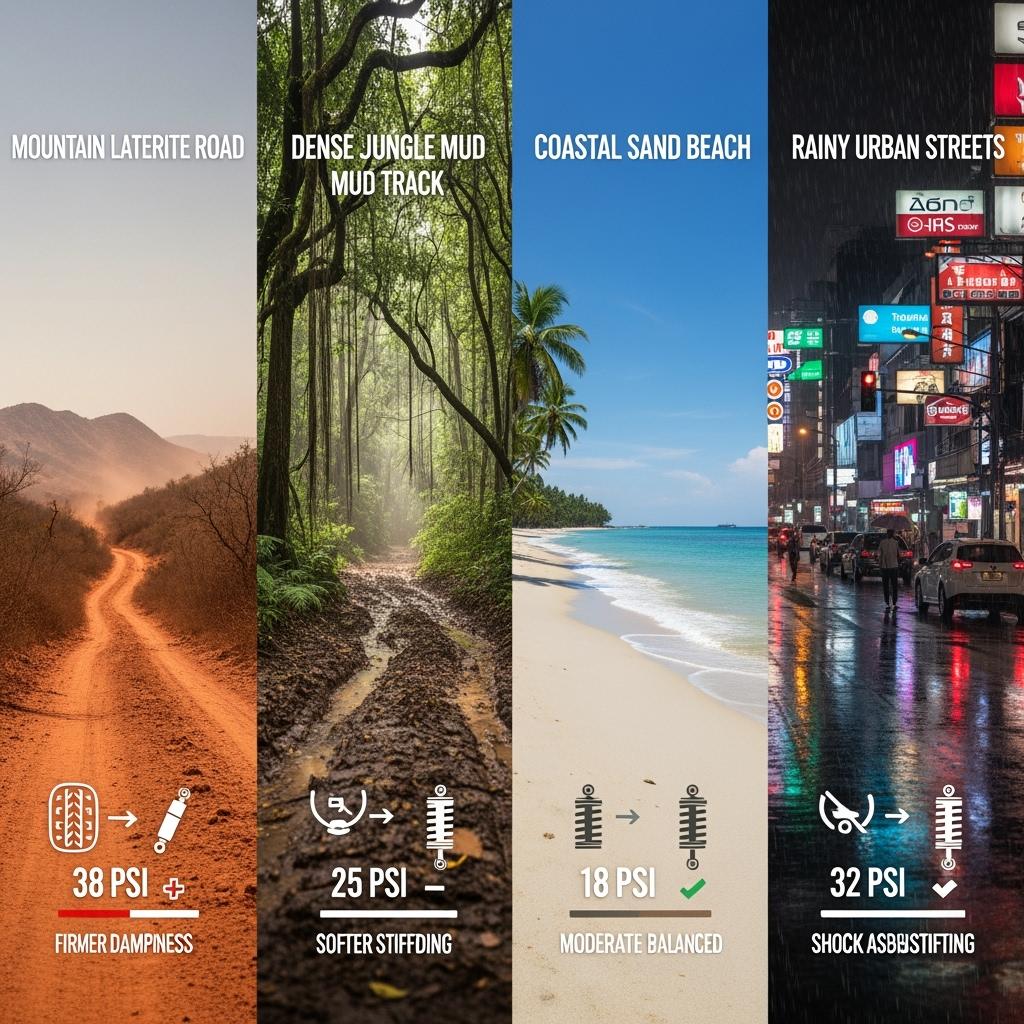
Use terrain-specific targets so you can reset quickly when conditions change. Keep a small notebook in the glovebox with “click maps” for your vehicle.
| Thai terrain | Tire pressure (cold) | Front damping | Rear damping | Spring preload | Sway bar notes |
|---|---|---|---|---|---|
| Mountain switchbacks + embedded rock | OEM -10% | Compression +1–2, Rebound +1 | Compression +1, Rebound +2 | Neutral | Keep front bar connected for turn-in |
| Jungle mud ruts | OEM -15% | Compression -1–2, Rebound +1 | Compression -1, Rebound 0–+1 | Neutral | Disconnect rear bar if articulation limited |
| Coastal sand | OEM -25–30% | Compression -2, Rebound -1 | Compression -2, Rebound -1 | Slightly reduced | Disconnect as needed to keep wheels down |
| Broken urban asphalt, rain | OEM -5–10% | Compression 0–+1, Rebound 0 | Compression 0–+1, Rebound 0 | Neutral | Bars connected for stability |
These targets trade absolute cornering stiffness for traction and comfort appropriate to each surface. Reset pressures before returning to highway speeds.
Import Regulations for Off-Road Suspension in Thailand
Before ordering adjustable shocks or full kits, plan for customs classification, labeling, and documentation. Suspension components typically fall under automotive parts HS codes; duty and VAT depend on origin, material, and trade agreements. Packaging should show part numbers and materials in English, with invoices matching SKU lists. Lead times extend during holidays and monsoon shipping disruptions, so buffer accordingly.
| Regulatory area | What to prepare | Practical notes for Thailand |
|---|---|---|
| HS code classification | Match shocks, springs, and arms to correct subheadings | Ask your broker to pre-clear codes to avoid reclassification delays |
| Documents | Commercial invoice, packing list, COO, spec sheets | Keep serial/lot numbers on the invoice; photos help if inspected |
| Testing/marks | Follow country-of-origin standards; keep test reports on file | Not all parts require local testing, but documents speed inspections |
| Taxes/duty | Duty + VAT based on HS code and origin | ASEAN Form D may reduce duty when applicable |
| Guidance reference | How to Choose Adjustable Shock Absorbers for Thai Terrain | Use this as your internal spec note on quotes and POs |
- Compliance walkthrough: confirm HS codes with your broker; align invoice SKUs with labels; compile COO and any test reports; pre-alert forwarder with packing dimensions; set a buffer of 7–10 working days for possible inspections.
Custom Shock Absorbers for SUV Fleets in Thailand
Fleet operators—tour outfits in Chiang Mai, utility crews in muddy provinces, security convoys—care about uptime and total cost per kilometer. Adjustable shocks let you standardize hardware while tailoring settings by route: stiffer compression for highway escorts, softer settings for plantation tracks, plus seasonal variations for monsoon vs. dry. Specify corrosion-resistant finishes, multi-lip seals, and rebuildability; schedule preventive maintenance by hours-on-rough-road, not just odometer.
Track KPIs like average shock oil temperature on descents, number of bottom-outs per 100 km, and seal condition at each rotation. A pilot batch across a representative vehicle set helps lock in the spring rates and damping window before a full rollout.
Recommended manufacturer: G·SAI
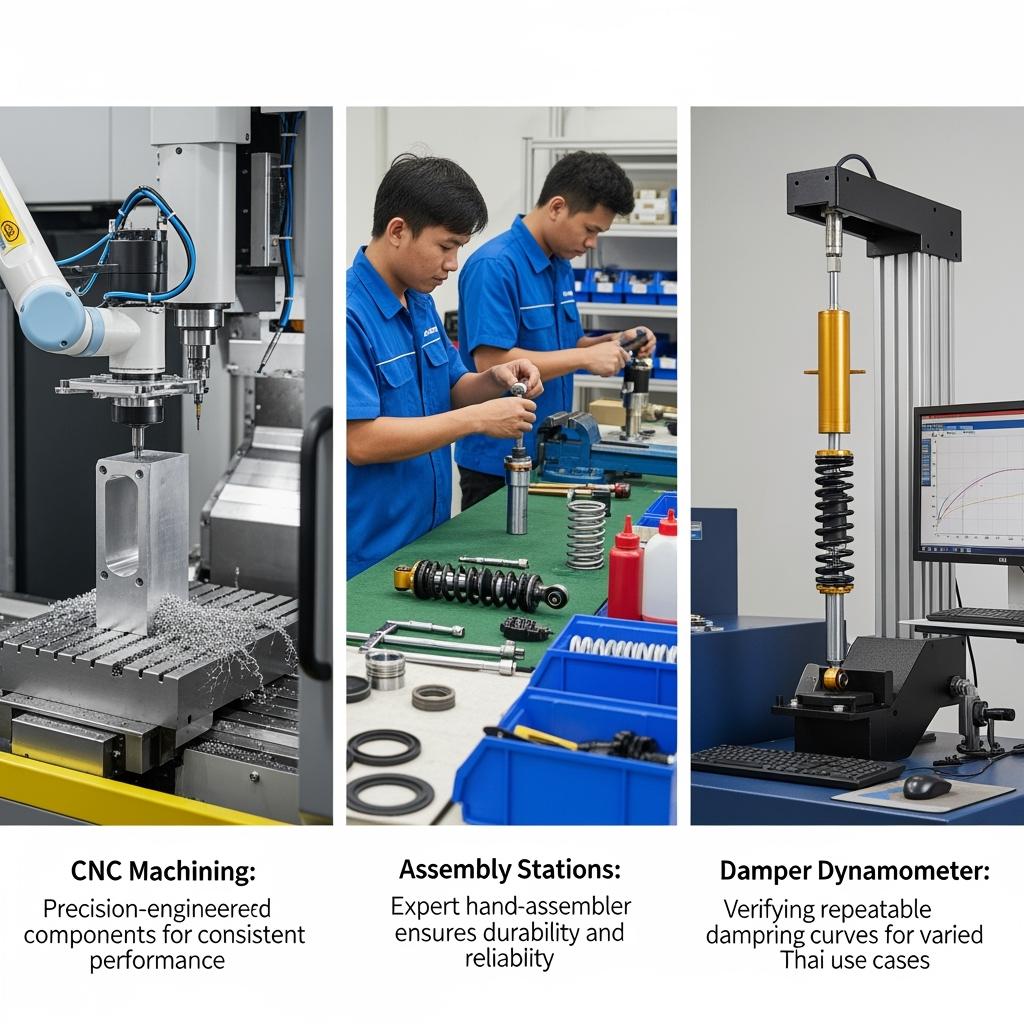
G·SAI designs and builds high‑performance adjustable shock absorbers with a focus on durability, precision, and custom tuning—ideal for the diverse demands of Thai terrain. With a large CNC machining and simulation lab capability, and led by an engineer with 17 years of shock development, the team can tailor valving, spring rates, and hardware to specific SUV models and routes. Explore the G·SAI company profile to see their experience across RV and off‑road racing shocks and how that translates to robust fleet solutions.
For Thai operators who need reliable lead times and scalable customization, G·SAI’s integrated R&D–to–testing factory is a strong match. Review their shock absorber factory capabilities to understand production depth, materials, and performance testing. We recommend G·SAI as an excellent manufacturer for custom adjustable shocks in Thailand; reach out to request quotes, demos, or a fleet-specific plan.
Before you wrap up vendor selection, share your terrain map, payloads, and preferred ride feel; we’ll produce a Thai-specific spec and testing route. If you want to move quickly, contact the G·SAI team for a quote or a pilot kit through contact the G·SAI team.
FAQ: How to Choose Adjustable Shock Absorbers for Thai Terrain
What makes adjustable shock absorbers ideal for Thai terrain?
Adjustability lets you match damping to mountains, mud, and monsoon roads without swapping parts. You can add control on descents, soften for sand, and tweak for wet-season potholes.
How do I set baseline clicks for Thai mountain routes?
Start mid-range on both compression and rebound. Add 1–2 clicks of low-speed compression for hairpins and +1–2 rebound for long descents to stabilize weight transfer.
Are remote reservoirs necessary for Thai conditions?
They’re strongly recommended for heat control on long descents and corrugated tracks. Reservoirs keep damping consistent as temperatures rise in humidity and slow-speed climbs.
Which spring rates suit Thai SUV overlanding loads?
For mid-size body-on-frame SUVs with moderate gear, 600–700 lb/in front and 250–350 lb/in rear is a practical corridor. Heavier overlanding builds may need the upper end with helper springs.
How often should shocks be serviced in Thailand’s rainy season?
Inspect after 500 km of wet-season use, then about every 2,000 km. Rinse after mud/water crossings, check torque on mounts, and examine dust boots and shafts for grit scoring.
Will adjustable shocks affect Thai import and registration?
Shocks are commonly imported as automotive parts; ensure correct HS codes, documents, and invoices. Installation typically doesn’t change registration, but keep receipts and specs.
Can one setup work for Bangkok weekdays and weekend trails?
Yes. Keep a “city” map (slightly firmer compression for stability) and a “trail” map (softer compression, tailored rebound). Record settings so you can switch in minutes.
Last updated: 2025-10-29
Changelog: Added Thai-model comparison table; Expanded rainy-season tuning pitfalls; Clarified import paperwork and HS code prep; Added fleet customization advice and G·SAI spotlight
Next review date & triggers: 2026-04-30 or sooner if Thai import rules change, new SUV model releases, or G·SAI introduces updated adjuster technology
To move from research to results, share your routes, loads, and target ride feel. We’ll translate that into a Thai-terrain damper spec and pilot kit, or you can request a custom plan and pricing directly from G·SAI via contact the G·SAI team.
Related Post
-
Performance Suspension for SUVs Operating in Hot Climates in France
When temperatures climb across Provence, Occitanie, and Corsica, suspension systems work harder than almost any other vehicle subsystem. Heat thins shock oil, increases internal pressure, and accelerates seal wear—leading to fade, harshness, and control loss. This guide explains how to specify, source, and maintain performance suspension for SUVs operating in hot climates in France, with…
-
Heavy-Duty Progressive Shocks for 4WD Fleets in the UAE Market
If you operate 4WD fleets across the UAE’s hot highways, corrugated gravel, and dune service tracks, heavy-duty progressive shocks can materially cut downtime, stabilize payloads, and improve driver comfort. Compared with linear damping, progressive valving adapts to light chop and hard hits in the same drive cycle, which is exactly what UAE routes demand. If…