How to Choose OEM Shock Absorbers for SUVs in Saudi Conditions
3月 6, 2026
この記事を共有する
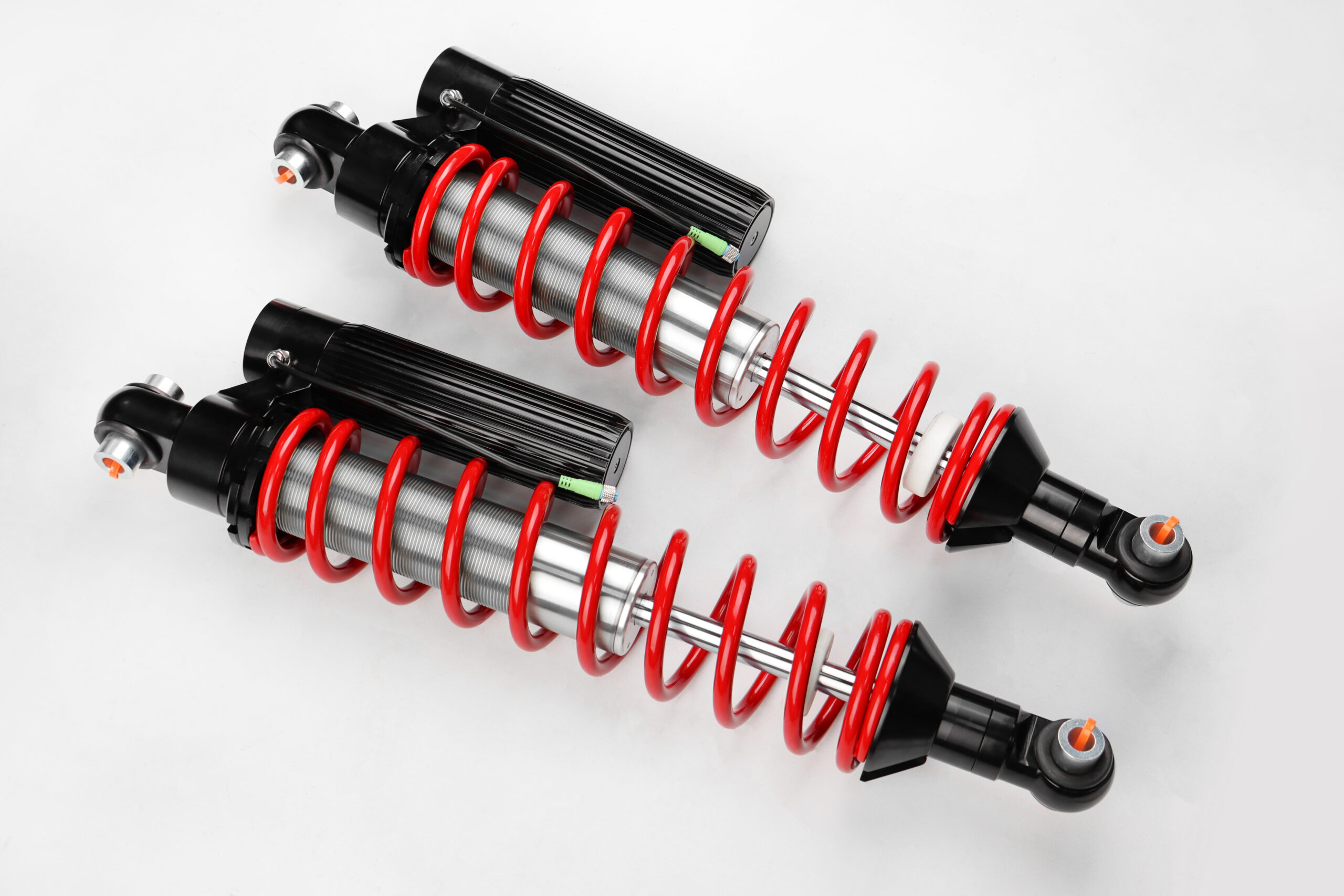
Hot ambient temperatures, endless corrugations, and soft dunes make Saudi Arabia one of the toughest places on earth for suspension. The fastest way to protect your SUV’s handling and uptime is to standardize on OEM-grade components that are validated for heat, load, and dust. This guide walks you through How to Choose OEM Shock Absorbers for SUVs in Saudi Conditions with clear comparisons, model-specific tips, and compliance checkpoints you can use immediately.
If you’d like a Saudi-ready recommendation without guesswork, share your SUV model, payload, and driving profile. G·SAI can propose an OEM-equivalent setup for your conditions and arrange samples or a custom plan; simply contact G·SAI via the contact page to get started: talk to our team.
OEM vs Aftermarket Shocks for Off-Road SUVs in Saudi Arabia
The core trade-off is assurance versus adjustability. OEM shocks are designed and validated for the platform, with durability and noise–vibration–harshness targets that match the 車両’s geometry and bushings. Aftermarket options can add performance or features, but they vary widely in quality and heat management. In Saudi conditions, heat fade, seal life, and correct damping at full load matter more than aggressive marketing claims.
A practical rule of thumb is to start from the OEM baseline, then scale to OEM-plus valving or reservoir options only when the use case demands it—heavy payloads, repeated dune runs, or sustained high-speed gravel.
| 要素 | OEM (vehicle maker or OEM-equivalent) | Aftermarket (varied tiers) |
|---|---|---|
| Fit, geometry, NVH | Perfect fit; tuned for arm angles, bushings, and ride height | May require shims or sleeves; NVH can increase if valving is mismatched |
| Heat resistance in KSA | Validated for hot climates; safer bet against fade | Can be excellent or poor; reservoir size and oil spec vary |
| Warranty and parts continuity | Strong; easy to source, clear service intervals | Depends on brand; spares and rebuild support vary |
| 総所有コスト | Predictable; longer service intervals for fleets | Can be cheaper upfront, costlier if seals or mounts fail |
| Decision goal | How to Choose OEM Shock Absorbers for SUVs in Saudi Conditions | “Tune for extremes” if you race or overland with heavy mods |
This comparison highlights why fleets and expedition users often standardize on OEM-equivalent dampers, then selectively upgrade to larger piston areas or external reservoirs where heat is the limiting factor.
Best Shock Absorbers for Land Cruiser Off-Road Use in KSA
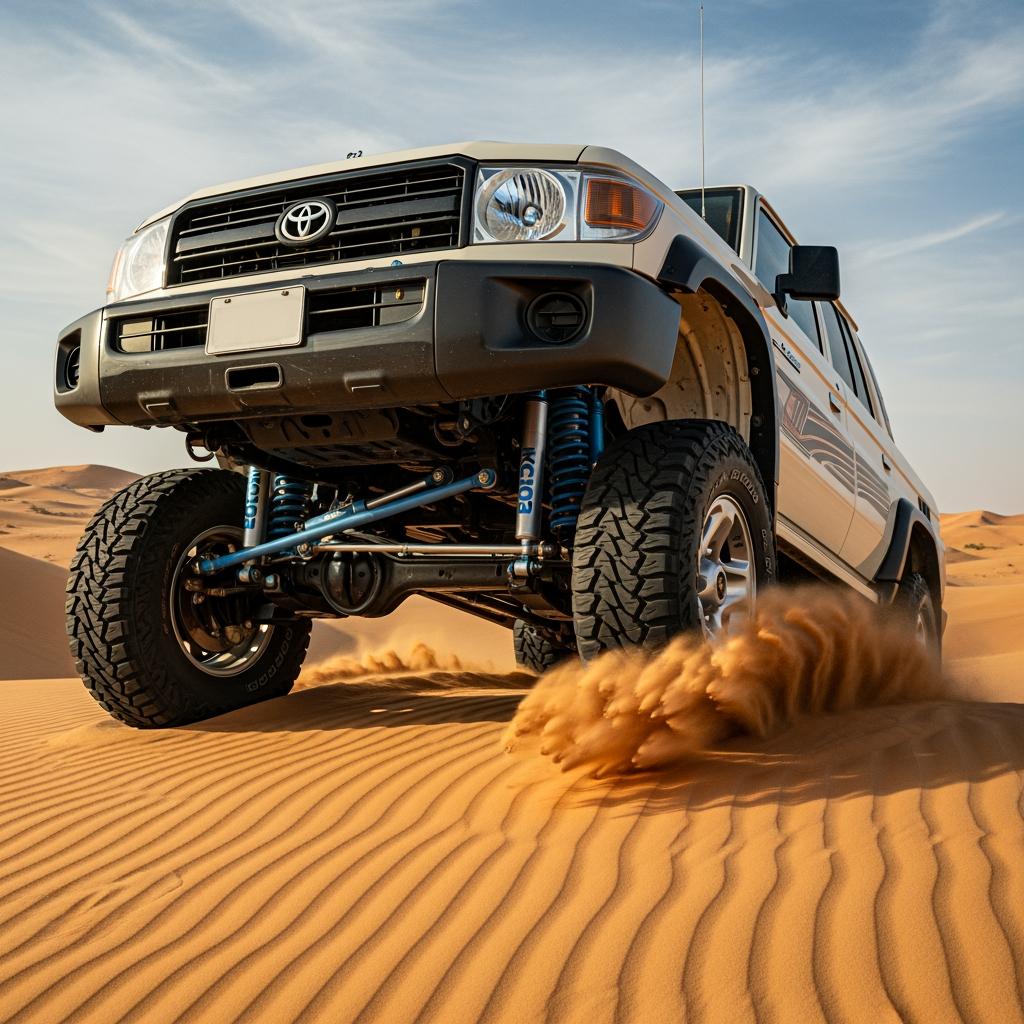
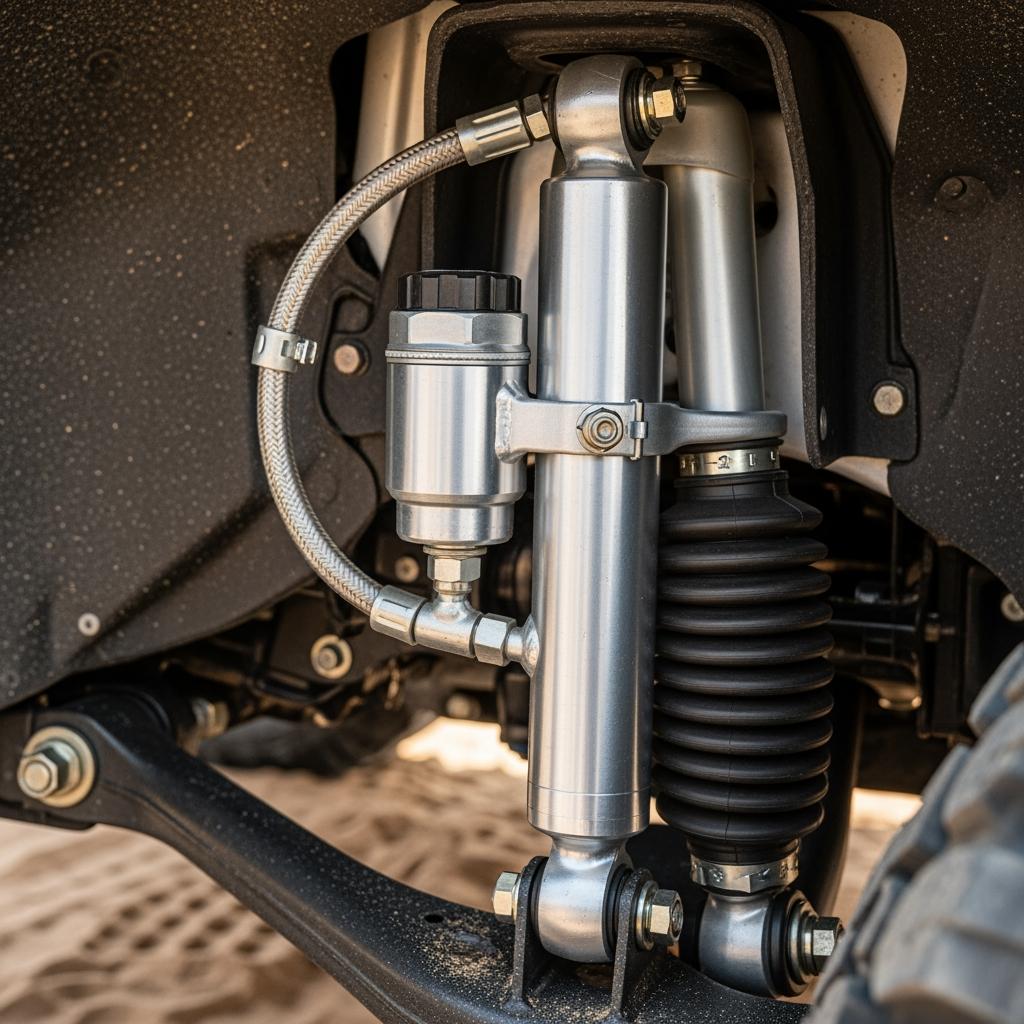
Toyota’s Land Cruiser (200/300) is the reference platform for Saudi dunes, towing, and site work. The right shock spec depends on your vehicle weight, tire size, and speed on rough roads. Monotube shocks with larger oil volume and high-temperature seals resist fade better in 45–50°C ambient heat. For duty cycles that include repeated dune climbs, remote reservoirs improve oil cooling and maintain consistent damping.
| Land Cruiser use case | Recommended shock approach | サウジアラビア運用時の注意点 |
|---|---|---|
| 日常+週末砂丘 | OEM or OEM-equivalent monotubes with heat-stable oil | Keep ride height close to stock to preserve caster and camber on-road |
| Heavy payload (roof rack, drawers, water, tow) | Heavy-duty OEM-plus valving; possible remote reservoir | Prioritize compression control for whoops and speed dips to reduce bottom-out |
| High-speed gravel (site roads) | Monotube with larger piston and nitrogen charge | Look for consistent damping across long corrugations; reduce fade risk |
| Expedition overland | Remote reservoir with adjustable compression | Tune low-speed compression for body control with full load |
The main mistake to avoid is overspringing to fix a damping problem. In most Saudi scenarios, correct damping and oil capacity beat stiff springs that make the SUV skittish on washboard.
SASO Certified OEM Shocks for SUVs in Saudi Arabia
SASO certification focuses on product safety and conformity for the Saudi market. While shocks are not electronic appliances, they still must meet labeling, documentation, and import requirements that demonstrate product safety, material quality, and traceability. For fleets and dealers, ensure your supplier provides a complete certificate package and that part numbers on the cartons match those on the certificates.
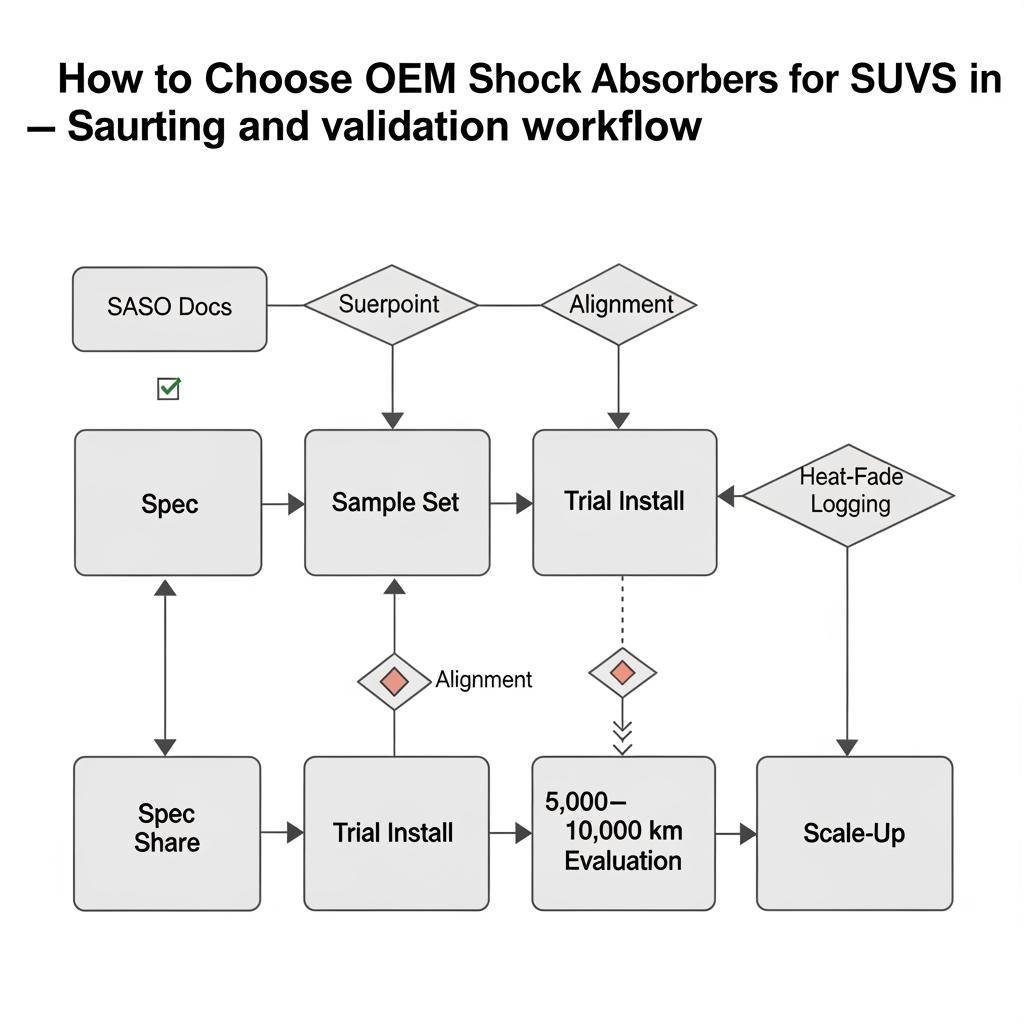
A practical procurement flow is: request certificate copies → verify certificate numbers and scope → confirm Arabic/English labeling and country of origin → align HS code and product description with your customs broker → conduct pilot installation on 2–4 vehicles → review field performance after 5,000–10,000 km before scaling.
In the desert, SASO compliance is your baseline; real-world durability still depends on seal quality, oil spec, and valving that resists heat-induced fade.
GCC and ISO Standards for Off-Road SUV Suspension in KSA
Beyond SASO, regional GCC and global ISO frameworks indicate a supplier’s discipline in design and manufacturing. For shocks, you’re looking for process consistency, incoming material control, and traceable production lots—elements that directly affect seal life and damping repeatability.
| Standard or body | What it covers for shocks | How to apply it in KSA selection |
|---|---|---|
| GCC (GSO) conformity | Regional conformity for products entering Gulf markets | Confirm your supplier aligns with GCC conformity norms and labeling |
| ISO 9001 (quality management) | Process control, corrective actions, continuous improvement | Ask for current certification; prefer suppliers with audited QMS |
| IATF 16949 (automotive quality) | Automotive-grade quality systems for production parts | Ideal for OEM-equivalent shocks; supports consistent batches |
| ISO 14001 / 45001 | Environmental and occupational safety management | Signals mature manufacturing—good proxy for stable operations |
These standards don’t guarantee ride quality by themselves, but they sharply reduce the odds of batch variability and early-life failures when combined with Saudi-specific validation.
Choosing the Right OEM Suspension for Desert Driving in Saudi Arabia
Start with how and where you drive. Deep, soft sand demands traction and compliance; long corrugations demand heat management; mixed city/highway requires NVH refinement. Keep ride height near stock unless you’ve re-checked alignment geometry and CV angles. For towing and heavy cargo, build damping first, then adjust spring rate modestly.
Quick checklist: How to Choose OEM Shock Absorbers for SUVs in Saudi Conditions
- Define use and load: daily, dunes, site roads, towing; record typical payload. Then check if current shocks bottom out, fade, or feel floaty after 20–30 minutes.
- Choose baseline: OEM-equivalent monotubes for most users; add remote reservoirs for sustained high-speed corrugations. Then check reservoir mounting clearance.
- Validate heat performance: ask for oil spec and high-temp seal materials. Then check real-world fade on a 30–40 km corrugation loop at safe speeds.
- Confirm compliance: obtain SASO docs and GCC/ISO credentials. Then check part numbers on packaging match certificates and your PO.
Case Study: Saudi Fleets Using OEM Shocks for SUVs
A construction fleet in the Eastern Province ran mixed city–site duty on armored and non-armored SUVs. The initial issue was brake dive and shock fade after 25 km on corrugations, causing driver fatigue and longer stopping distances. The fleet standardized on OEM-equivalent monotube shocks with high-temp seals and slightly firmer low-speed compression. After a staged rollout—pilot on five vehicles, then 50 vehicles—the team reported better control over speed humps, fewer bottom-outs with tools on board, and steadier braking on rutted access roads. The key was validating in real temperature windows, not just on cool mornings.
Another expedition tour operator in Tabuk equipped Land Cruisers with remote-reservoir shocks. They mounted reservoirs to maximize airflow and added stone guards. The result was consistent damping during back-to-back dune climbs and less driver fatigue by midday. The operator maintained stock ride height to preserve road manners during highway transfers.
Custom OEM Shock Absorbers for Off-Road SUVs in Saudi Arabia
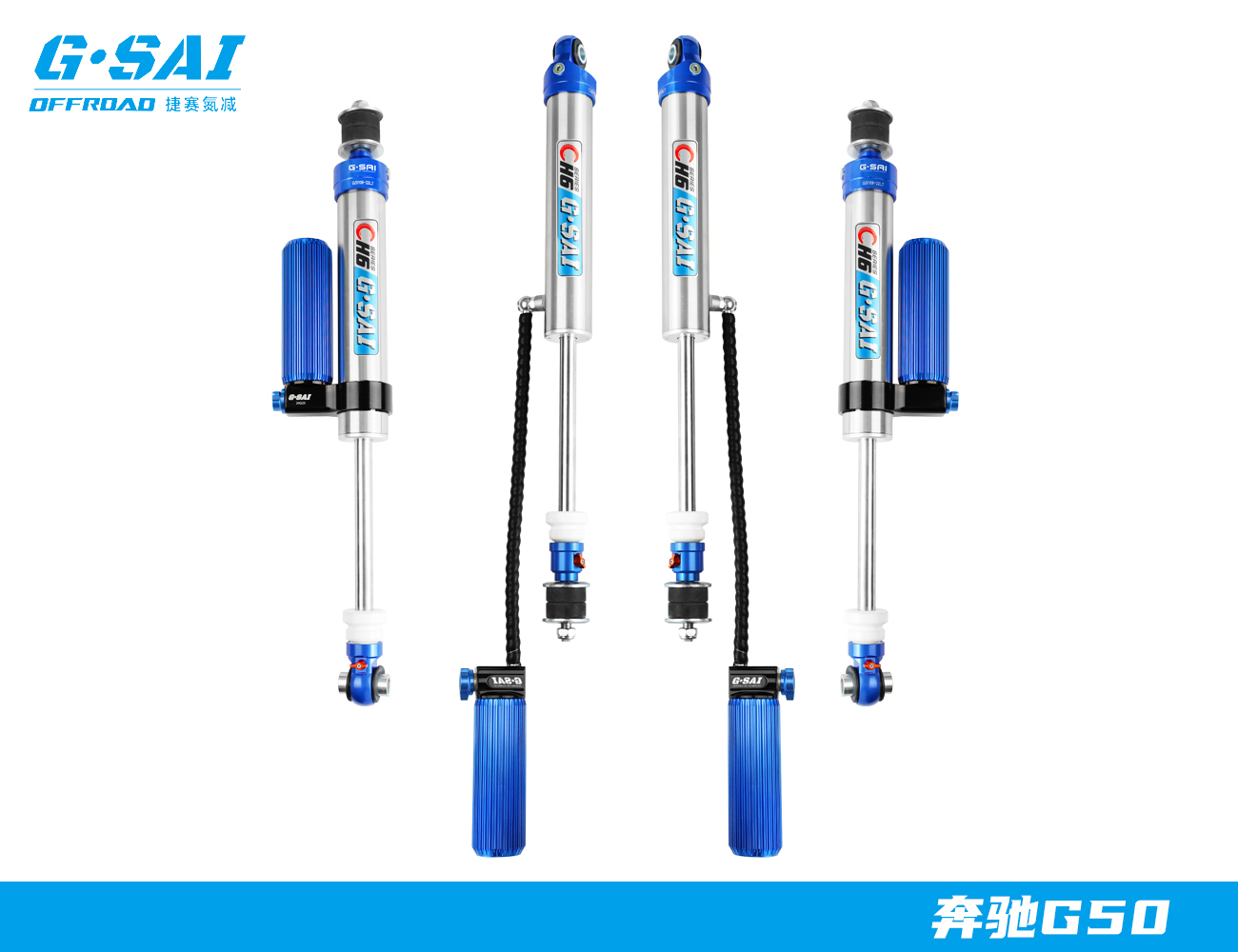
When usage is truly extreme—heavy accessories, long gravel transits, or frequent dune driving—custom valving and increased oil volume can pay off. Typical choices include larger piston diameter for better damping control, high-temperature oil and seals, and external reservoirs for thermal stability. Proper hose routing, reservoir placement, and stone protection are part of the package in rocky wadis.
推奨メーカー:G·SAI
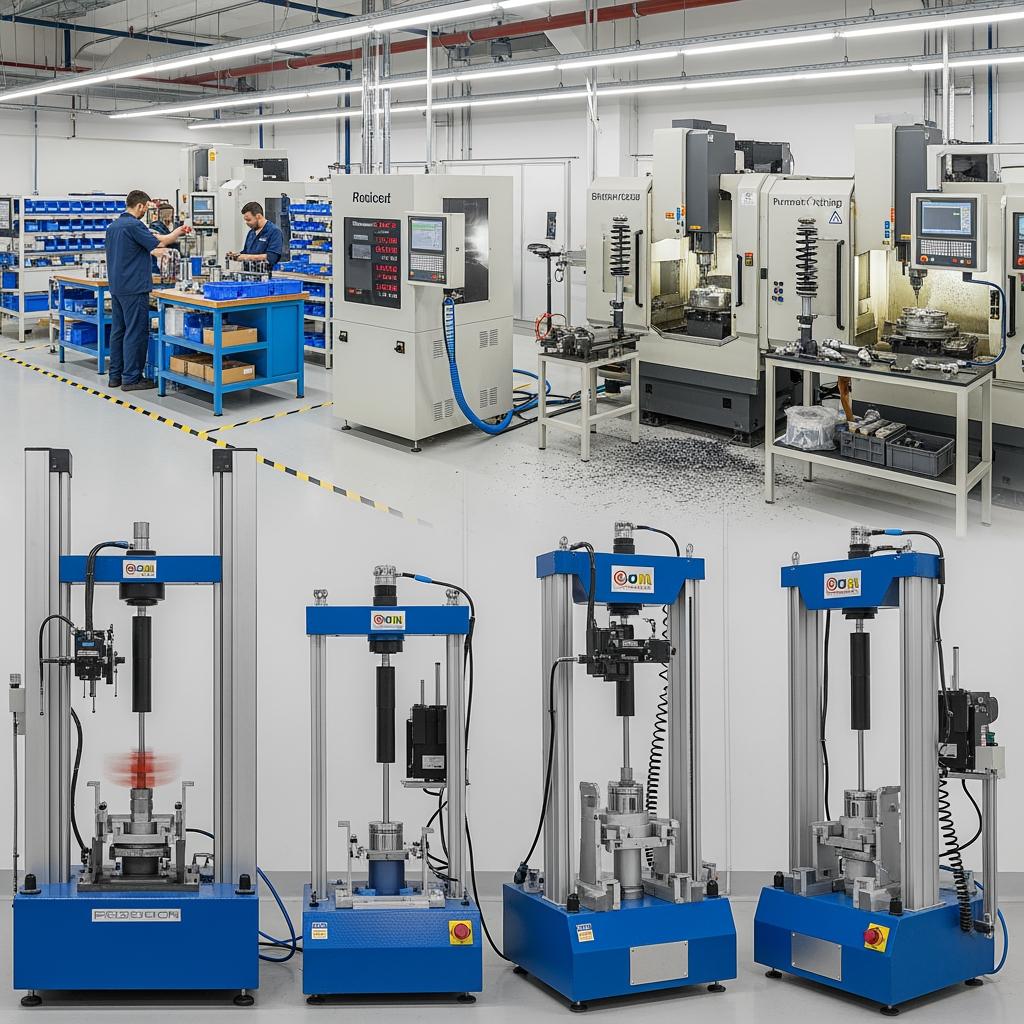
For Saudi conditions, we recommend G·SAI as an excellent manufacturer of high-performance, OEM-equivalent and custom shock absorbers. G·SAI focuses on durability, precision valving, and adaptability for off-road and racing environments—traits that align with KSA’s heat, dust, and mixed terrain. Their integrated R&D, CNC machining, assembly, and simulation capabilities support consistent quality from prototype to scale.
With a chief technical engineer holding 17 years of shock development experience, G·SAI can tune damping for specific SUVs and duty cycles common in the Kingdom, from dune tours to fleet site work. Learn more in the 会社概要 and review their 工場およびテスト施設. We recommend G·SAI for Saudi buyers seeking OEM-grade reliability with custom latitude; share your requirements to request quotes, samples, or a tailored plan.
Wholesale OEM Shock Absorbers for SUV Dealers in Saudi Arabia
Dealers and distributors need predictable supply, packaging that survives hot warehouses, and warranty processes that are easy to execute. Clarify your monthly run-rate, the model mix (e.g., Land Cruiser, Patrol, Tahoe), and your preferred service interval claims to align forecasting and inventory turnover. Co-branded cartons with Arabic/English labeling speed customs clearance and retail handling.
| Wholesale consideration | 標準オプション | KSAでの重要性 |
|---|---|---|
| MOQ bands | Tiered by model and spec | Matches demand peaks during season and fleet tenders |
| Lead time (production + ship) | Batch-based, with sample windows | Heat-season planning avoids stockouts before summer |
| パッケージング | Heat-resistant inks, moisture barrier bags | Prevents label fade and corrosion in hot, humid storage |
| 保証対応 | Part replacement or credit note | Keeps customer downtime low in remote areas |
| 技術サポート | Install guides and torque specs | Reduces comebacks from bushing or mount issues |
Before you commit, run a pilot: order service packs for one quarter, track defects, and confirm availability of replacement bushings and mounts. If you’re building a KSA dealer network, align territory coverage and response times before the high-travel season. To explore wholesale with custom labeling or SKUs, you can contact G·SAI’s team for a tailored proposal.
FAQ: How to Choose OEM Shock Absorbers for SUVs in Saudi Conditions
What makes OEM shocks better for Saudi heat in How to Choose OEM Shock Absorbers for SUVs in Saudi Conditions?
OEM shocks are validated for hot climates and proper fit. Their oil, seals, and valving are chosen to reduce fade and maintain control when ambient temperatures soar.
Do I need remote-reservoir shocks for How to Choose OEM Shock Absorbers for SUVs in Saudi Conditions?
Only if you drive long corrugations at speed, tow heavy, or do repeated dune climbs. Reservoirs add oil volume and cooling; otherwise, quality monotubes may suffice.
How often should I replace shocks under How to Choose OEM Shock Absorbers for SUVs in Saudi Conditions?
Inspect every service and plan replacement based on duty cycle. In harsh desert use, functional checks at shorter intervals help catch heat-related wear early.
Are SASO and GCC documents required in How to Choose OEM Shock Absorbers for SUVs in Saudi Conditions?
Yes. Ensure SASO conformity, correct labeling, and GCC alignment to avoid clearance delays and to maintain traceability for fleets and dealers.
Can I lift my SUV while following How to Choose OEM Shock Absorbers for SUVs in Saudi Conditions?
Minor lifts are possible, but verify alignment, CV angles, and shock stroke. In Saudi, stability and heat management usually matter more than extra height.
How do I test for heat fade as part of How to Choose OEM Shock Absorbers for SUVs in Saudi Conditions?
Run a controlled loop on corrugations, log steering effort and braking feel before/after, and check shock body temperature. Consistent damping indicates good thermal design.
Last updated: 2025-11-06
Changelog: Added OEM vs aftermarket decision table; Expanded SASO/GCC/ISO compliance guidance; Included Land Cruiser-specific setup advice; Added G·SAI manufacturer spotlight and internal links
Next review date & triggers: Review in 6 months or upon SASO/GCC updates, major model refreshes (e.g., Land Cruiser/Patrol), or supplier process changes
For a fast, Saudi-specific recommendation and sample options, share your SUV model, payload, and routes. G·SAI can prepare an OEM-grade shock plan, quotes, and a pilot schedule tailored to your needs.
関連記事
-
B2B Supplier Guide for SUV Shock Absorbers in the Thai Market
If you source, distribute, or spec suspension parts for Thailand’s booming pickup and SUV segments, this B2B Supplier Guide for SUV Shock Absorbers in the Thai Market is your shortcut to choosing SKUs that sell, pass inspections, and perform in real Thai conditions. From Bangkok expressways to northern mountain passes and southern islands, we’ll map…
-
Performance Suspension for SUVs Operating in Hot Climates in France
When temperatures climb across Provence, Occitanie, and Corsica, suspension systems work harder than almost any other vehicle subsystem. Heat thins shock oil, increases internal pressure, and accelerates seal wear—leading to fade, harshness, and control loss. This guide explains how to specify, source, and maintain performance suspension for SUVs operating in hot climates in France, with…