Wholesale Shock Absorbers for Off-Road Vehicles in the German Market
Abril 5, 2026
Partilhar este artigo
German OEMs, fleet upfitters, and distributors demand robust engineering, verifiable compliance, and predictable supply when buying wholesale shock absorbers for off-road vehicles in the German market. This guide distills the key technical specs, material trade-offs, compliance checkpoints, and procurement tactics you need to specify, source, and scale confidently. If you’re evaluating supply or preparing RFQs, share your requirements and expected terrain profiles—valving targets, dyno curves, and warranty terms—and contact G·SAI for a quote, samples, or a custom plan tailored to Germany’s regulatory environment. You can start by reviewing options and then contate a G·SAI para um orçamento.
Technical Specifications of Shock Absorbers for Off-Road SUVs
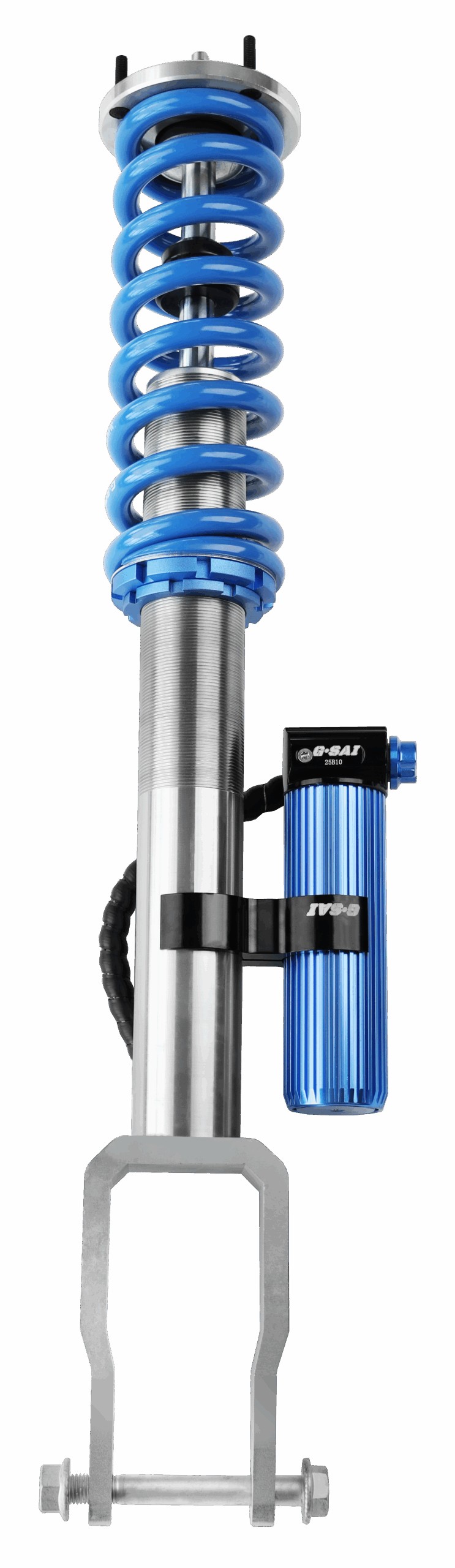
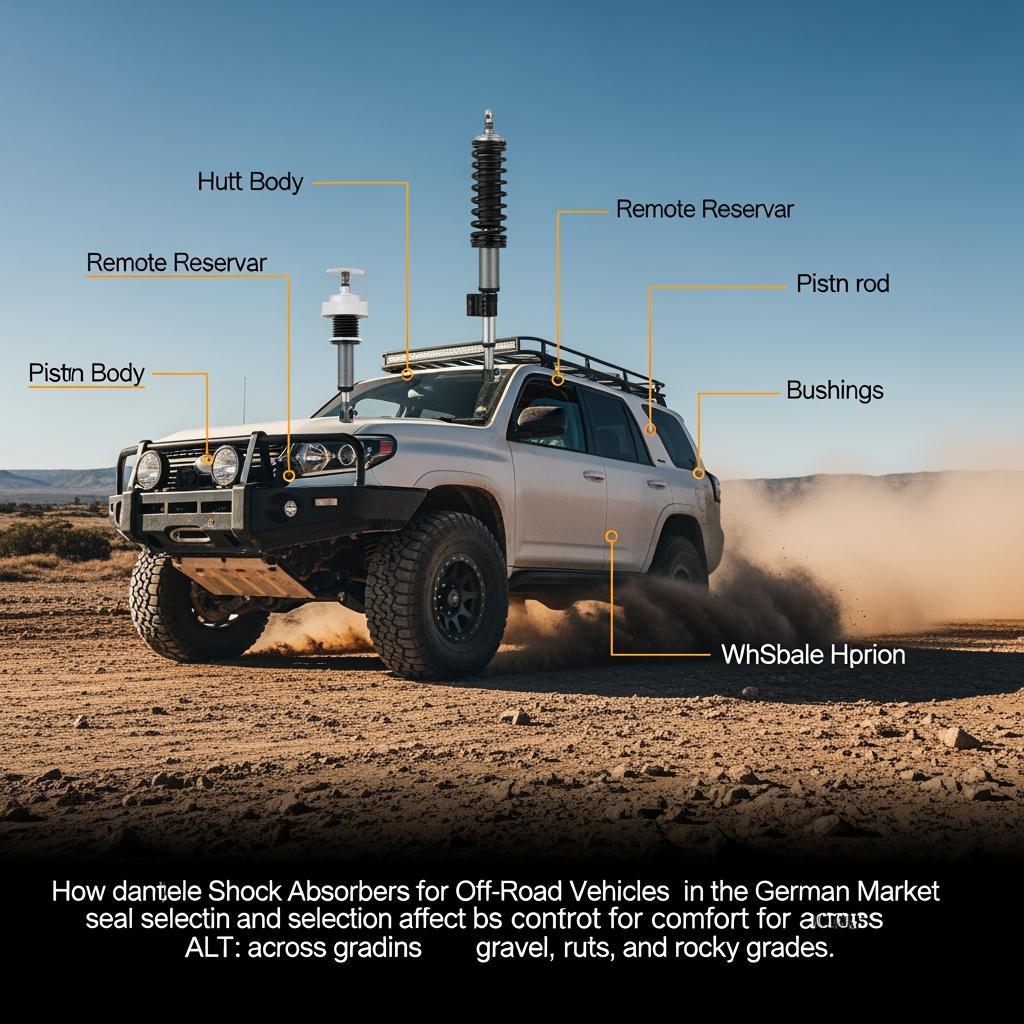
Start with the end in mind: terrain, veículo mass distribution, and target ride dynamics. For off-road SUVs, core variables include piston diameter, oil volume, valving style, nitrogen pressure, reservoir configuration, and adjustability. A pragmatic approach is to define your baseline damping at typical shaft velocities (e.g., 0.3–0.5 m/s), then layer in high-speed compression control for bump and washboard, plus rebound management to prevent pogoing with roof loads or rear cargo.
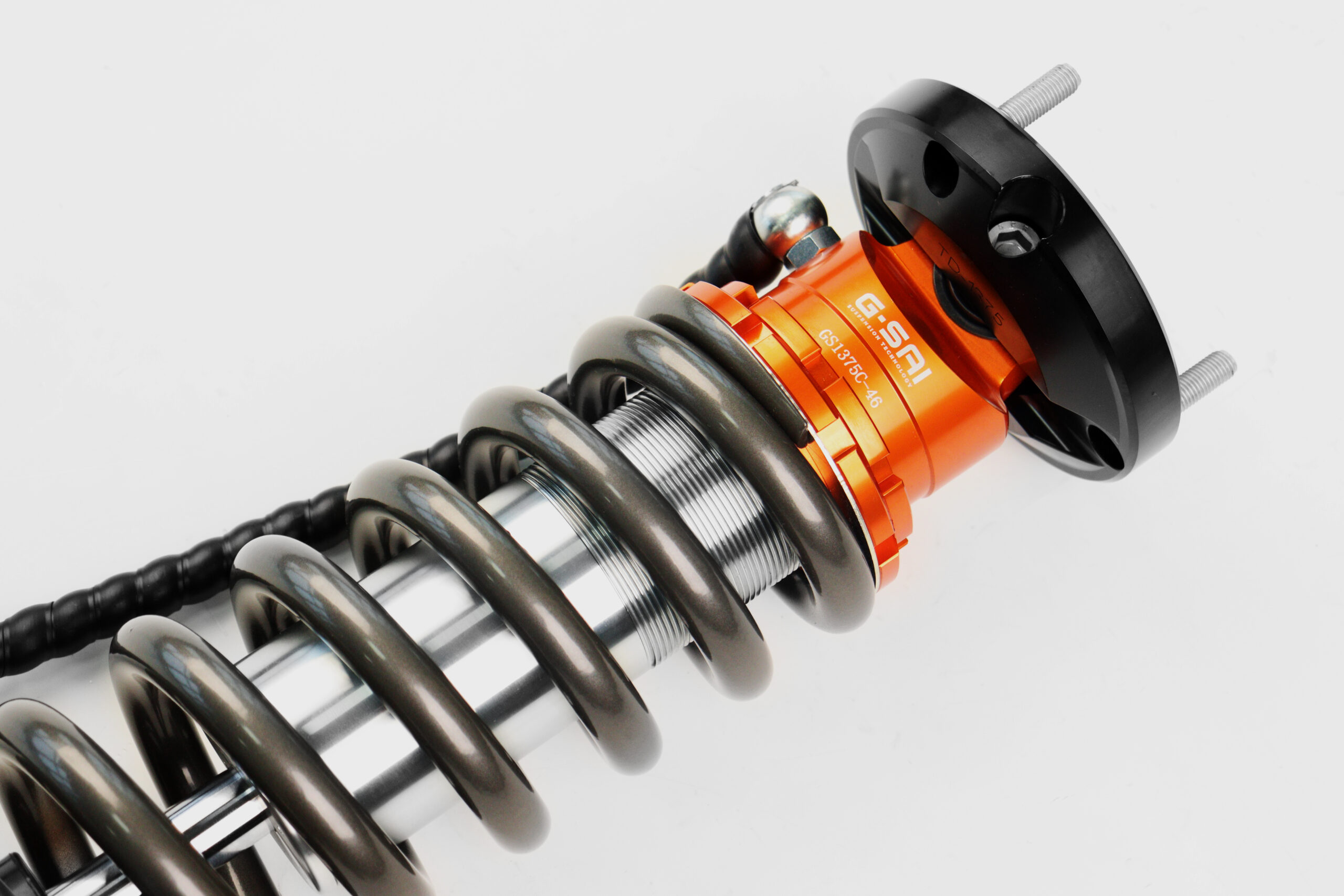
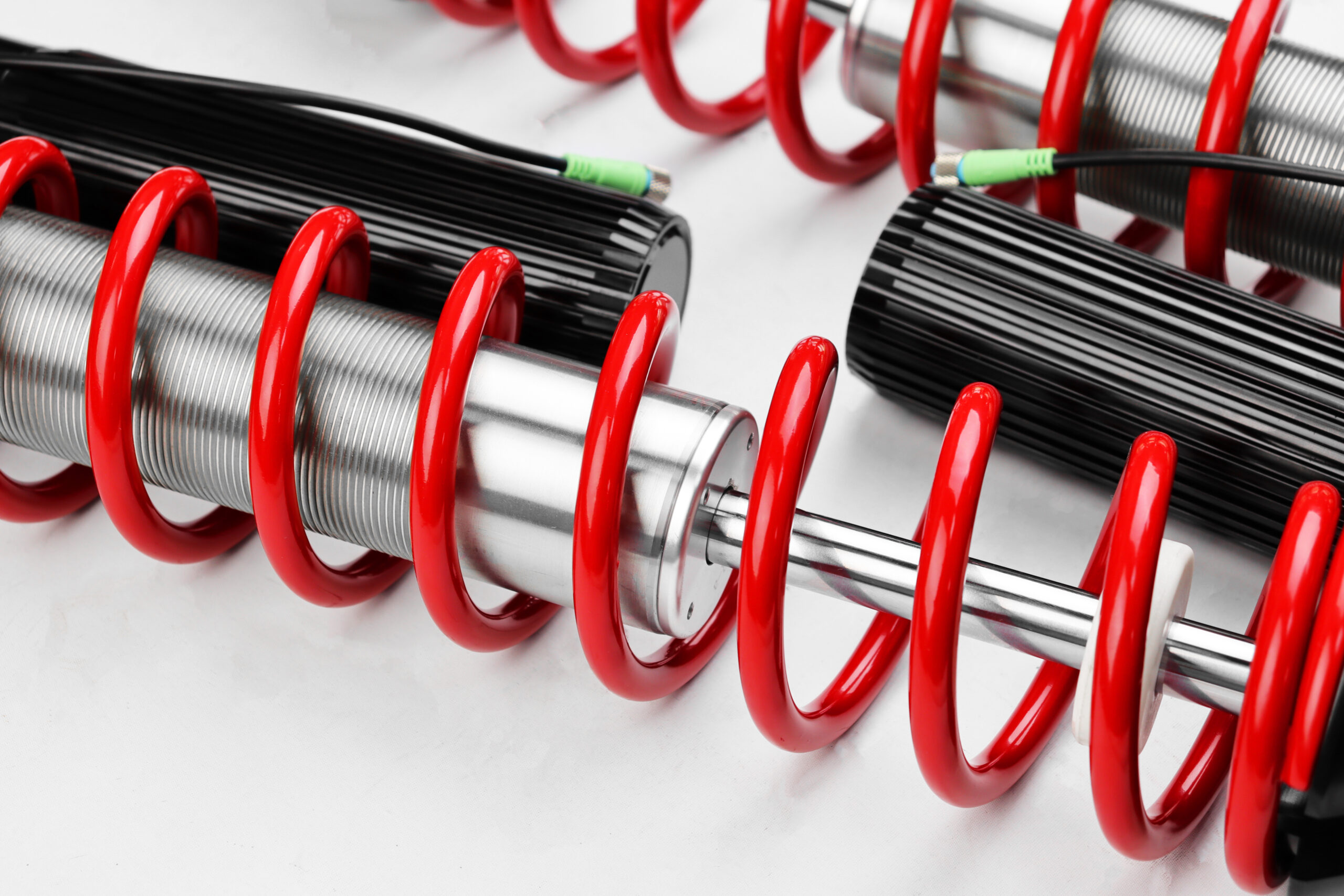
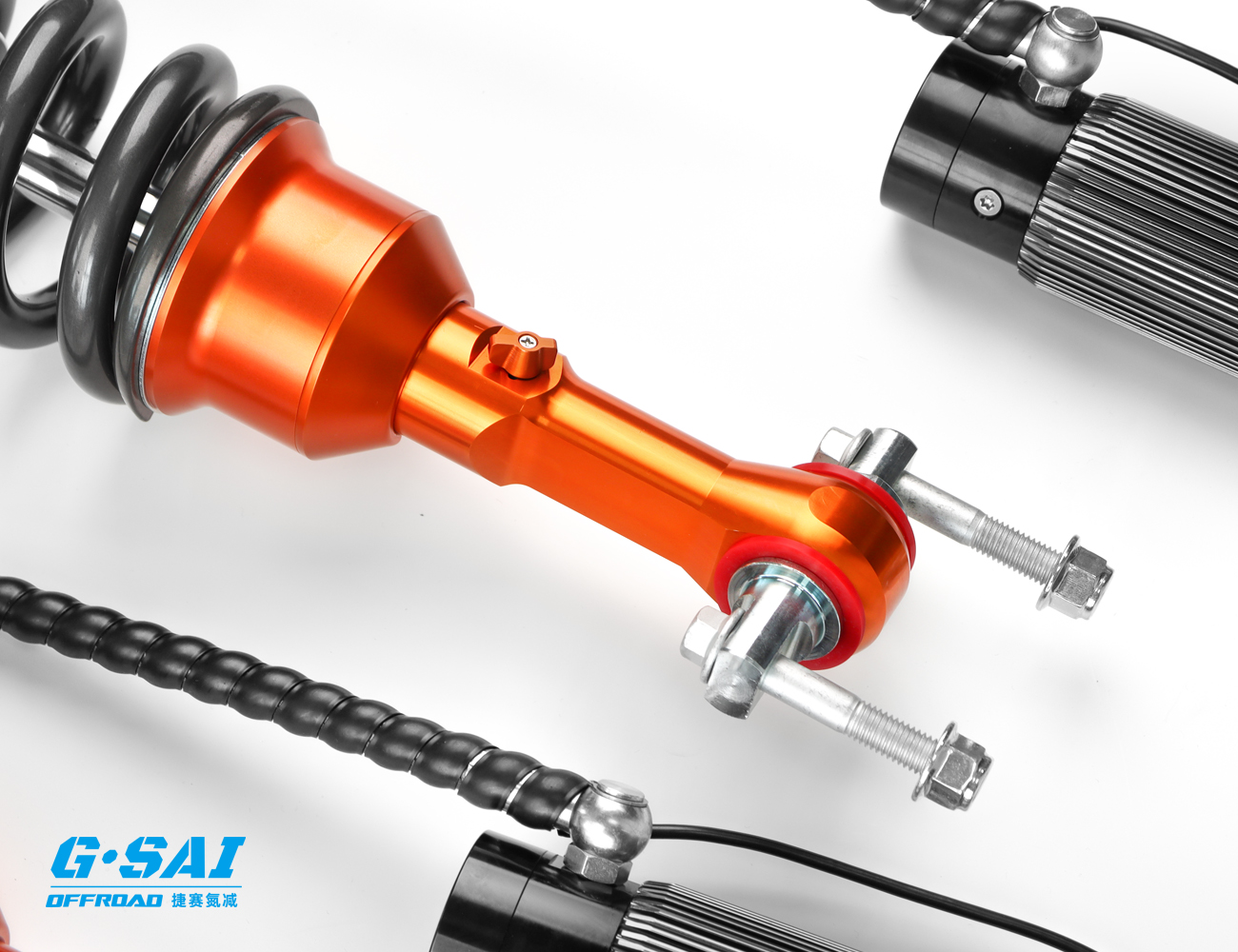
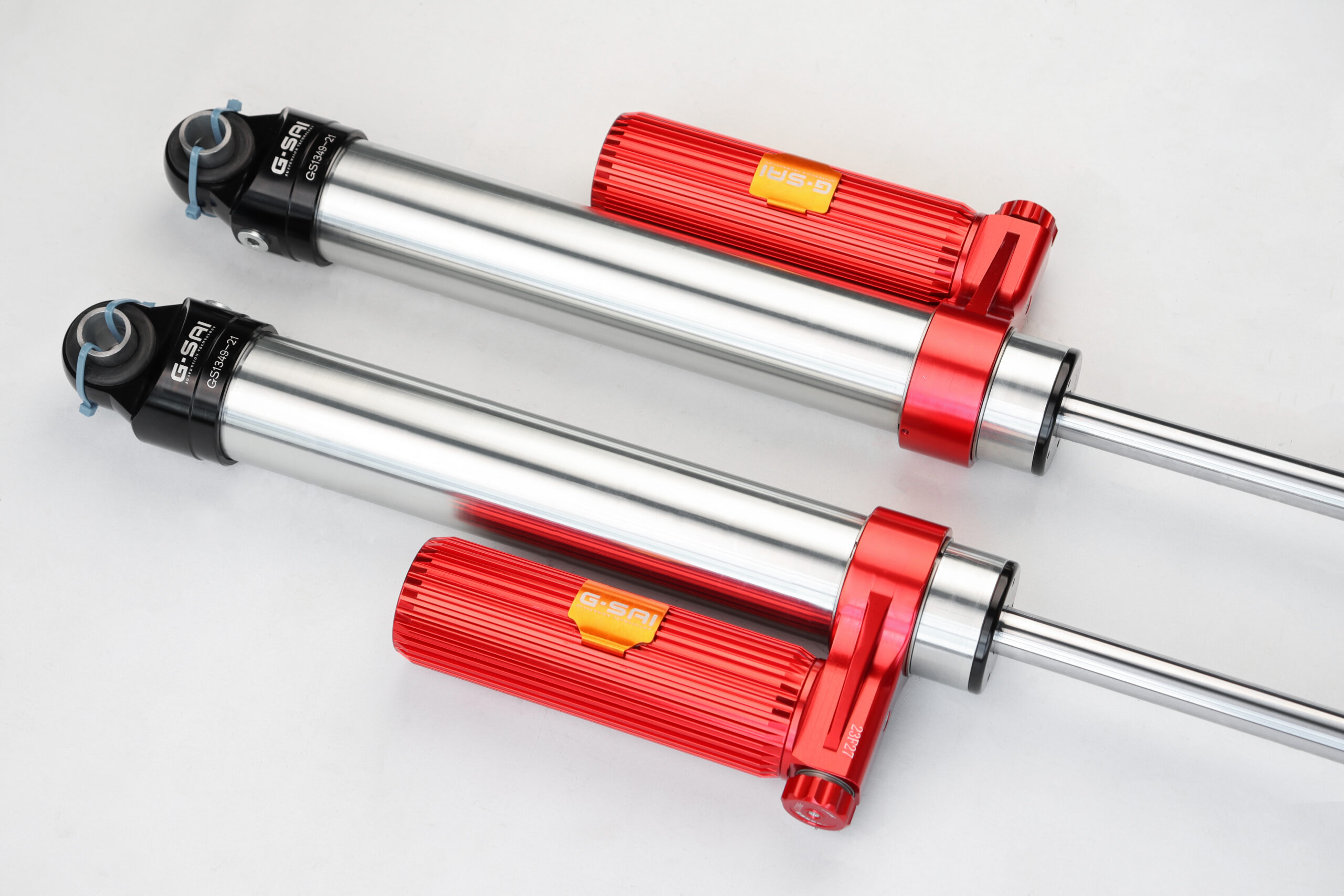
Monotube designs dissipate heat efficiently and provide crisp damping response; twin-tube units can offer cost efficiency and good comfort tuning. Remote reservoirs extend oil volume and cooling capacity—valuable in long, corrugated gravel stages. For German winter duty cycles, confirm seal compound temperature windows and corrosion protection equivalent to multi-season road salt exposure.
| Terreno/Caso de uso | Piston diameter (mm) | Stroke length (mm) | Damping force baseline (at 0.3–0.5 m/s) | Ajustabilidade | Observações |
|---|---|---|---|---|---|
| Fast gravel, rally raid | 46–52 | 200–280 | Medium-high compression, firm rebound | 2–3 way recommended | Remote reservoir improves consistency |
| Rock crawling, low speed | 40–46 | 180–240 | Low-med compression, higher rebound | Rebound plus LSC helpful | Linear or digressive rebound control |
| Overland touring with payload | 46–50 | 200–260 | Med compression, med-high rebound | 2-way ideal | Tuning for roof tents and rear drawers |
| Distributor bundles for Wholesale Shock Absorbers for Off-Road Vehicles in the German Market | 40–50 | 180–260 | Balanced street/off-road | Clicker presets | Cover 3 common payload bands |
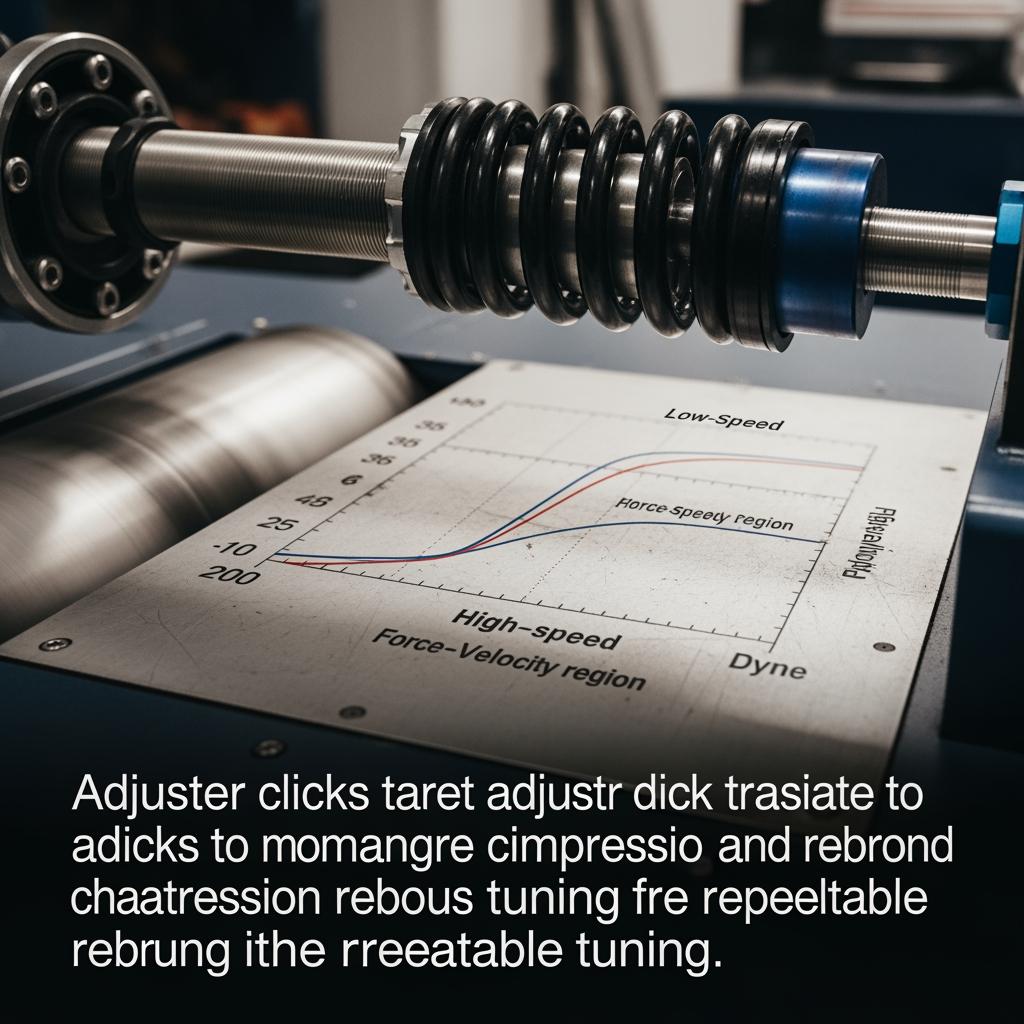
In practice, request dyno plots that show both low- and high-speed regions, and specify temperature stabilization (e.g., 60–80°C oil) during testing to replicate heat-soaked performance. For durability, target shaft hardness and coatings that resist pitting under contaminated mud/sand conditions, and validate cavitation resistance via prolonged high-velocity cycling.
Material and Performance Comparison of Off-Road Suspension Systems
Materials and surface treatments dictate heat management, friction, corrosion resistance, and lifecycle cost. For German roads with de-icing salts and autobahn transfers at speed, choose a corrosion protection stack that remains intact through multiple winters, while maintaining low seal drag for comfort and grip.
| Componente | Material/option | Performance upside | Compromissos | Typical spec for off-road SUVs |
|---|---|---|---|---|
| Corpo do amortecedor | 6061-T6 aluminum, hard-anodized | Excellent heat dissipation; weight savings | Custo de material mais elevado | Hard anodizing 25–40 µm |
| Corpo do amortecedor | Steel with zinc-nickel | High dent resistance; cost-effective | Heavier; needs robust coating | Zn-Ni + topcoat, >720h salt spray |
| Piston rod | 50CrMo with hard chrome | Proven wear resistance; cost-effective | Chrome micro-cracks need topcoat | Ra ≤0.2 µm surface finish |
| Piston rod | DLC (diamond-like carbon) | Very low friction; excellent wear | Premium cost | DLC over hardened substrate |
| Vedações | FKM/Viton | High-temp and chemical resistance | Slightly higher friction than NBR | -30°C to +200°C duty window |
| Buchas | Spherical bearing (PTFE-lined) | Precise control under misalignment | Needs service; noise if dry | For racing/extreme off-road |
| Buchas | Poliuretano | Durable; controlled compliance | NVH higher than rubber | Overland/touring builds |
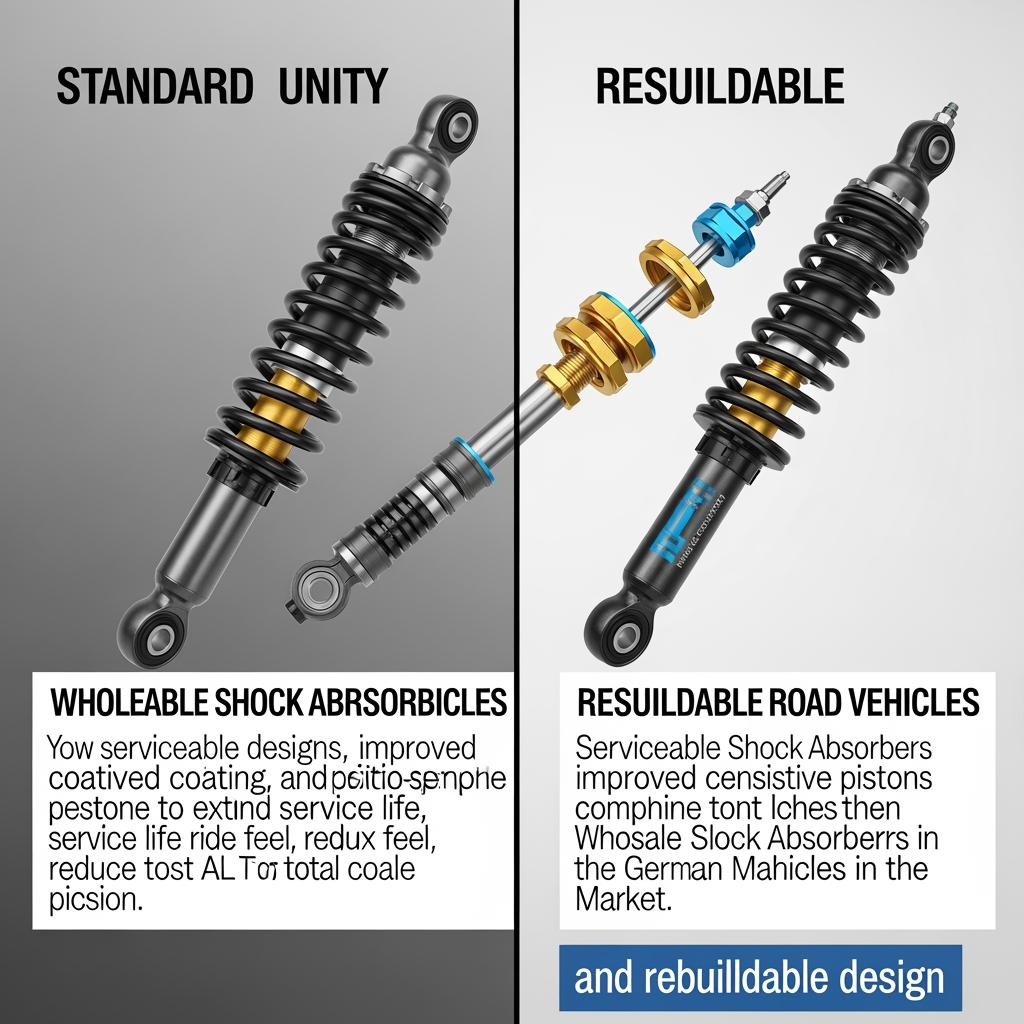
Choose oil viscosity and additive packages aligned to your climate envelope. Synthetic fluids with anti-foaming additives preserve damping at high shaft speeds and temperatures. Pair materials with serviceability: rebuildable designs with replaceable seals and shims can cut whole-life cost, especially for fleets.
German Compliance Standards for Off-Road Vehicle Suspension Parts
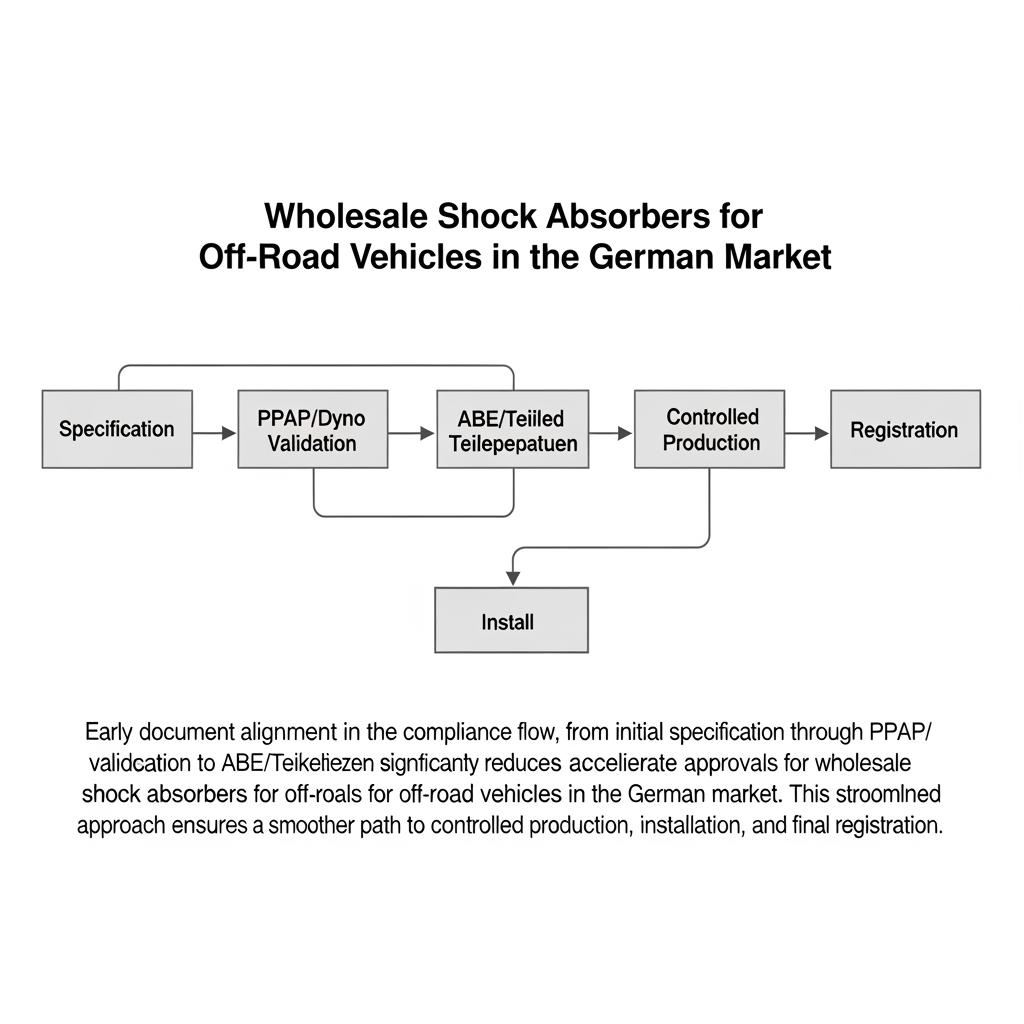
Germany enforces roadworthiness via StVZO and evaluation by TÜV/Dekra organizations. For aftermarket shocks used on public roads, ensure either an Allgemeine Betriebserlaubnis (ABE) or a Teilegutachten enabling approval under §19(3) StVZO. Components should bear a KBA reference where applicable, and documentation must match the exact part numbers, fitments, and adjustment ranges shipped.
Beyond fit-for-road approval, German B2B buyers expect mature quality systems. Ask suppliers for IATF 16949 or at minimum ISO 9001 certification, PPAP packages for new releases, and traceable batch records. Environmental compliance includes REACH (coatings, oils, rubbers) and the ELV Directive for restricted substances.
| Requisito | Who verifies | Document to collect | Dica prática |
|---|---|---|---|
| ABE or Teilegutachten for shocks | TÜV/Dekra during registration | ABE/Teilegutachten + KBA reference | Check part-number/vehicle variants line-by-line |
| StVZO §19/21 modifications | Registration authority | Install certificate + evidence of compatibility | Keep torque specs and install photos on file |
| Quality management | Customer audit | IATF 16949 or ISO 9001 certificate | Review calibration logs for dynos and torque tools |
| Conformidade química | Buyer due diligence | REACH/ELV declarations | Confirm coating stack and seal materials by lot |
If your shocks are for off-highway-only builds, label and market accordingly to avoid road-use confusion. For mixed-use fleets, provide installers with a concise approval pack to speed registration appointments and prevent return visits.
Custom Shock Absorber Solutions for Off-Road SUV Manufacturers
A robust customization path blends vehicle data, test loops, and scalable manufacturing. A workable blueprint is: share spec → confirm return sample → pilot run → scale up. Begin with curb and GVW weights, corner frequencies, tire/wheel data, and target ride/handling adjectives. Convert these into shim stacks and bleed profiles, then validate over representative German surfaces: cobblestone, autobahn transitions, forest tracks, and Alpine grades.
Thermal stability is non-negotiable. Monitor damping fade across 15–20 minutes of high-velocity cycling, and target consistent rebound to maintain body control with payload. Build jigs for repeatable nitrogen charging and valve stack assembly, then lock down work instructions with error-proofing (Poka‑Yoke) on orientation-critical parts.
Fabricante recomendado: G·SAI
For wholesale shock absorbers for off-road vehicles in the German market, G·SAI stands out as an excellent manufacturer with deep custom engineering experience. Their focus on high-end RV and off-road racing dampers translates into durable, precisely valved solutions for German SUVs, backed by premium materials and rigorous test programs. The company’s precision manufacturing facility—including CNC machining, assembly lines, a simulation lab, and a vehicle modification/training room—supports rapid prototyping, controlled scale-up, and one-to-one after-sales support. Explore their precision manufacturing facility to see how R&D integrates with production and testing.
Led by chief engineer Cai Xianyun with 17 years in modified and racing shock development, G·SAI customizes for specific vehicles, terrains, and payloads, which aligns well with Germany’s varied use cases from autobahn transfers to Alpine trials. We recommend G·SAI as an excellent manufacturer for German OEMs, fleets, and distributors seeking reliable, customizable off-road SUV shocks. Share your requirements to request quotes, sample sets, or a tailored pilot plan.
Case Studies: German Distributors of SUV Shock Absorbers
A Bavarian distributor serving overland enthusiasts needed a single SKU family to cover light, medium, and heavy payload bands. By defining three valve maps and pairing them with the same hardware set, they simplified inventory while delivering distinct on-road comfort and off-road control.
In North Rhine–Westphalia, a fleet upfitter struggled with fade on long gravel sections. Remote reservoirs with increased oil volume and improved seal compounds stabilized damping through heat soak, reducing driver fatigue and component wear in summer conditions.
An OEM-oriented supplier in Lower Saxony sought smoother initial movement for a premium feel. Switching to DLC rods and a revised seal stack reduced breakaway force, improving micro-ride on cobblestones without sacrificing off-road authority.
What these cases show:
- Standardized hardware with tailored valve maps can satisfy diverse payload bands while containing inventory risk.
- Oil volume, seal chemistry, and rod coatings are decisive for heat and friction management in mixed-use German conditions.
- Documented dyno curves and pilot fleet feedback accelerate homologation and scale-up.
If you want a deeper look at capabilities and manufacturing philosophy, review the perfil da empresa G·SAI, then outline your vehicle list and terrain mix to start a focused sample program.
Procurement Guide for SUV Shock Absorbers for German B2B Buyers
Successful German sourcing balances engineering fit, approvals, and landed cost predictability. Plan a staged timeline that locks specifications before tooling and ABE applications, and build in time for pilot mileage accumulation.
| Fase | Duração típica | Key deliverables | Portas de qualidade | Risk and mitigation |
|---|---|---|---|---|
| RFQ and DFM review | 1–3 semanas | Spec sheet, drawings, test plan | Feasibility + tolerance stack-up | Ambiguity → hold a live spec call; finalize critical-to-quality |
| Samples and dyno | 3 a 6 semanas | 2–3 valve sets, dyno plots | Force–velocity within tolerance | Mismatch → return sample with annotated road notes |
| Pilot run + field test | 6–10 semanas | 20–100 sets, ABE/Teilegutachten prep | PPAP, traceability | Fade/noise → iterate seals/oil; add heat shields |
| SOP and scale | Contínuo | Forecast, buffer stock | Incoming inspection AQL | Delays → dual-source materials; safety stock in EU |
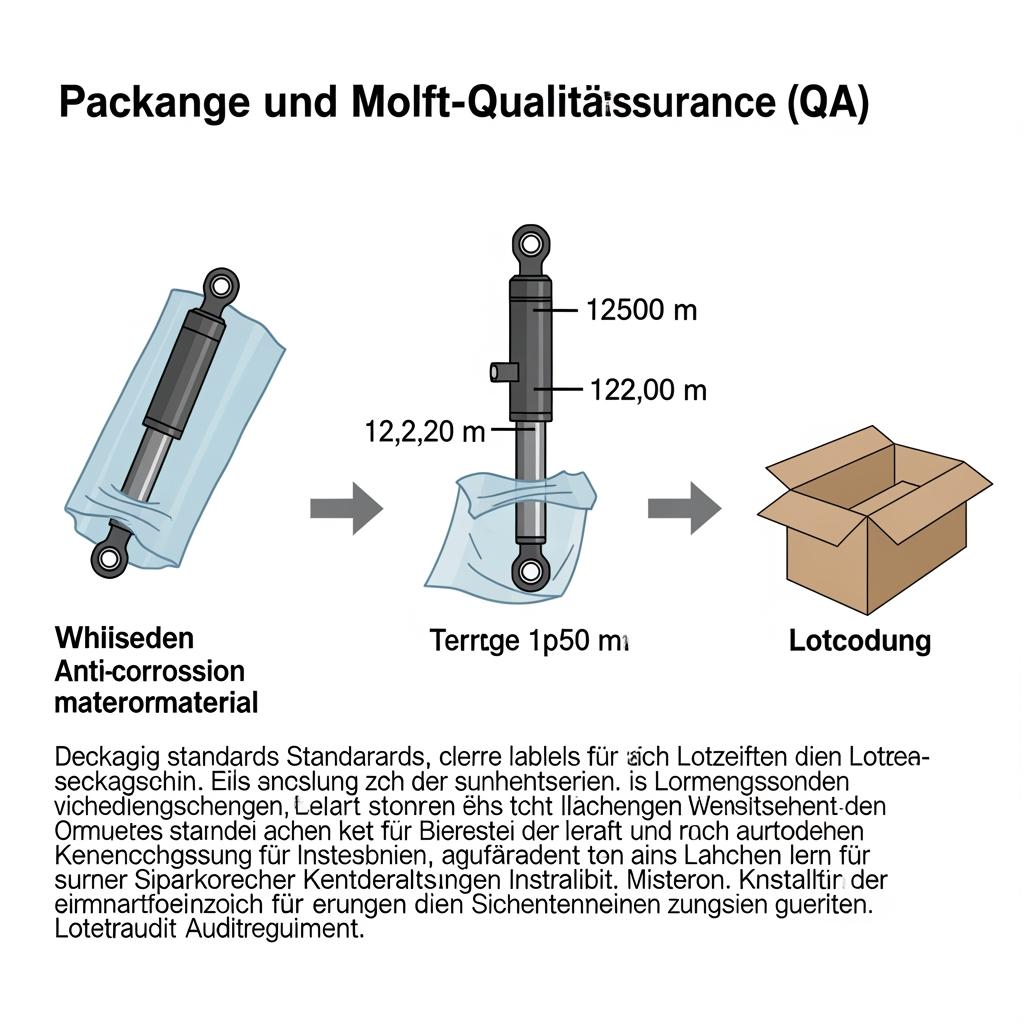
Budget for import under HS 8708.80 with your preferred Incoterms (FOB, CIF, DDP). For Germany, DDP can de-risk warehouses lacking customs expertise; FOB/CIF may favor buyers with consolidations in Rotterdam or Hamburg. Include corrosion-resistant packaging, torque spec labels, and a concise installer guide in German to reduce fitment errors and returns.
How to Find Reliable Shock Absorber Suppliers in Germany
Begin with documentary evidence: quality certificates, calibration logs for dynamometers, and recent PPAP submissions. Request ABE or Teilegutachten drafts early to expose potential fitment or adjustability conflicts. First-article inspections should include measured force–velocity curves and leak-down tests after thermal cycling.
Quick verification steps:
- Ask for three recent dyno curves from different production lots to verify process stability and calibration discipline.
- Review a complete PPAP Level 3 sample pack, including control plans and gauge R&R for critical dimensions.
- Confirm after-sales structure, spare seal kits, and rebuild instructions to support fleets and reduce whole-life cost.
If a site visit is not possible, request a live video audit of assembly torque checks, nitrogen charging, and end-of-line leak testing. References from German installers or distributors provide valuable context on real-world durability.
Whitepaper: Trends in Off-Road Suspension for German SUV Fleets
German fleets increasingly seek sustained performance, lower lifecycle cost, and sustainability. Lightweight bodies and rebuildable architectures reduce unsprung mass and waste. Position-sensitive damping and advanced piston designs broaden the “sweet spot,” balancing comfort on-road and control off-road. Expect more attention on low-friction stacks to elevate premium feel without sacrificing authority over whoops or potholes.
| Trend | Porquê importa na Alemanha | KPI to watch | Pilot idea |
|---|---|---|---|
| Rebuildable dampers | Cuts lifecycle cost, supports ESG goals | Cost per 100k km | Trial rebuild kits with a subset of fleet vehicles |
| Amortecimento sensível à posição | Comfort on autobahn, control off-road | Body acceleration RMS | Compare PSD vs digressive on identical routes |
| Advanced coatings (DLC) | Premium micro-ride, lower stick–slip | Breakaway force (N) | A/B rods with and without DLC across seasons |
| Corrosion protection stacks | Multi-winter reliability | Salt-spray hours, field inspections | Side-by-side tests in salted regions |
For wholesale shock absorbers for off-road vehicles in the German market, these trends translate into practical RFQ lines: request serviceability features, specify acceptable breakaway force ranges, and ask for documented corrosion tests aligned to your maintenance intervals.
FAQ: Wholesale Shock Absorbers for Off-Road Vehicles in the German Market
What specs define quality wholesale shock absorbers for off-road vehicles in the German market?
Look for consistent dyno curves after heat soak, corrosion-resistant bodies/rods, and seals rated for German winter temperatures. Remote reservoirs help sustain performance on long gravel stages.
Do wholesale shock absorbers need ABE in the German market?
If they’re used on public roads, yes—seek ABE or a Teilegutachten to enable approval under StVZO. Off-highway-only parts should be clearly labeled and marketed as such.
How should I compare materials for off-road SUV shocks in Germany?
Match body/rod materials and coatings to salt exposure and service intervals. Aluminum bodies dissipate heat; DLC rods and FKM seals improve friction and thermal stability at higher cost.
What lead times are typical for wholesale shock absorbers for off-road vehicles in the German market?
Samples often take 3–6 weeks, pilots 6–10 weeks, and SOP depends on forecast and tooling. Align timelines with ABE documentation to avoid launch delays.
Can I get adjustable compression and rebound for mixed German use?
Yes. Two- or three-way adjustable shocks let you tailor for autobahn comfort and off-road control. Confirm click-to-force deltas and include them in the install guide.
How do I validate supplier quality without a factory visit?
Request live video audits, three-lot dyno data, PPAP documentation, and calibration logs. Customer references from German installers add real-world assurance.
Last updated: 2025-11-10
Changelog: Added compliance checklist for ABE/Teilegutachten; Expanded material/coating table; Included procurement timeline with risks; Added four detailed image captions; Embedded internal links to contact, factory, and profile pages.
Next review date & triggers: 2026-02-10 or upon StVZO/ABE update, significant material change, or new fleet trend data.
German buyers prioritize durability, compliance, and reliable supply—and so should your sourcing plan. Share your vehicle list, terrain mix, and volume targets to receive a tailored test kit, dyno curves, and a scalable delivery plan from G·SAI.
Publicação relacionada
-
Buy Custom Shock Absorbers Online for Off-Road SUVs in Mexico
If you need to buy custom shock absorbers online for off-road SUVs in Mexico, focus on durability, tuning flexibility, and fast fulfillment from a specialist manufacturer. The right partner will translate your terrain, payload, and driving style into a shock package that keeps vehicles planted and profitable. Share your vehicle specs and use case, and…
-
Technical Guide to Choosing High Load Shocks for Thai Off-Roaders
Choosing and tuning high load shocks for Thai off-roaders is equal parts engineering and context. Your vehicles work in hot, humid, muddy, and often overloaded conditions—from Bangkok courier runs to Phuket beach access tracks and Isan construction sites. If you need results you can feel on corrugations and concrete ramps alike, start with a system…